
Why “I Can’t Afford Treatment” Isn’t Always the Full Story
Rhode Island just announced its second year in a row of decreasing overdose deaths. In 2024, 329 people died, down 18.6% from 2023 and 25% from 2022. The state is exceeding its goals. That’s really good news.
It is also incomplete news. Every percentage point in that decline represents someone who got into treatment before the window closed. Someone who figured out the insurance, made the call, and went. The number that does not appear in that headline is the one that matters just as much: how many people looked up what rehab costs, saw a figure that had nothing to do with reality, and quietly closed the tab.
This article is for them.
Does Blue Cross Blue Shield Cover Addiction Treatment in Rhode Island?
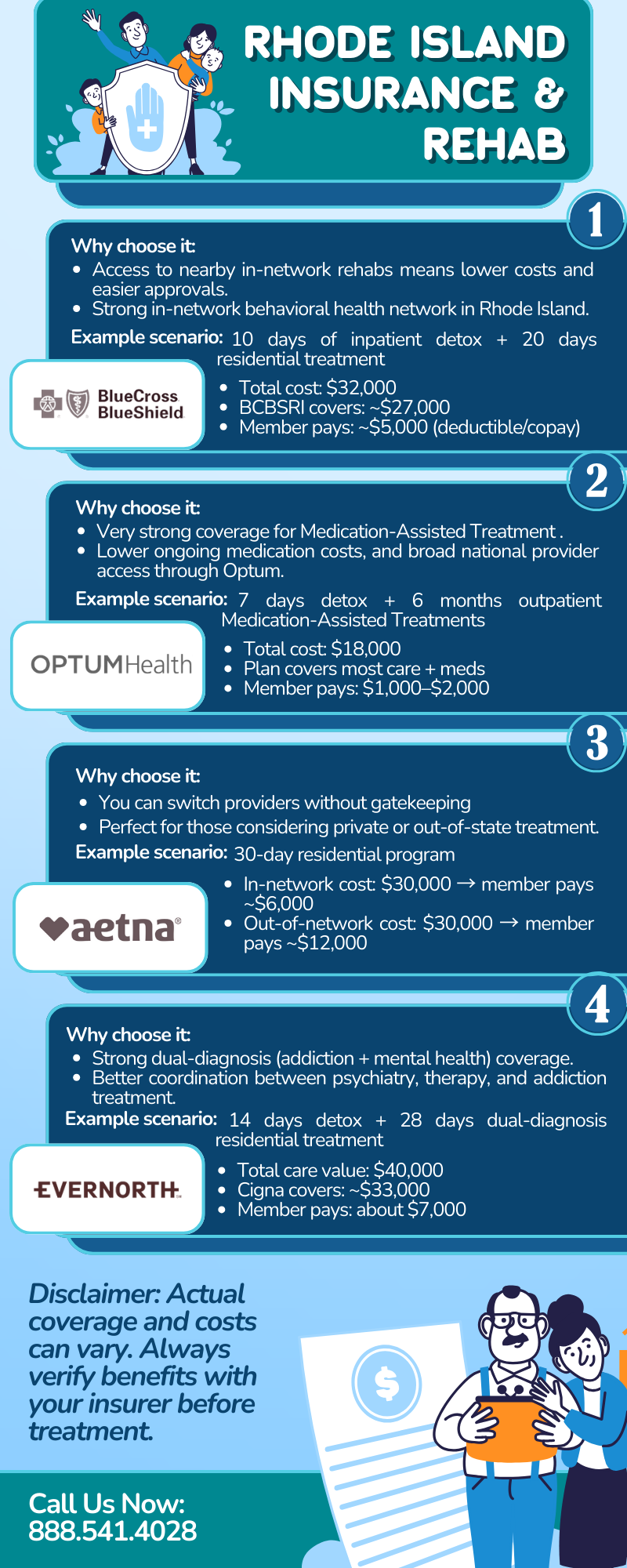
Absolutely. Not as a courtesy. Not buried in fine print. In fact, all BCBS marketplace plans must cover substance use disorder treatment as a mandatory essential health benefit under the Affordable Care Act. Alcohol, opioids, heroin, cocaine, marijuana, and prescription drugs. The substance does not change the answer.
Blue Cross Blue Shield of Rhode Island covers more than 375,000 members across the state, with over 10,000 in-network healthcare providers available to them. In-network is not a formality. It is the difference between a bill that makes sense and one that does not.
What BCBSRI Covers In Rhode Island
Addiction is not a single condition with a particular fix, and the coverage reflects that. BCBSRI coverage can assist with medical detox, inpatient and residential treatment, partial hospitalization programs, intensive outpatient programs, and standard outpatient care. Moreover, treatment for co-occurring disorders falls under the same category. Treating both at once is not asking for too much. It is asking for what works.
You will also find medication-assisted treatment listed on their website. Buprenorphine. Methadone at certified opioid treatment programs. These are not last resorts. They are first-line, evidence-based interventions, and they are covered as such.
The Law That Makes This Non-Negotiable
Federally, the Mental Health Parity and Addiction Equity Act draws a clear line: a health plan cannot impose more restrictions on substance use and mental health treatment than it does on medical or surgical coverage. That’s in terms of cost, length of coverage, or care management rules.
Rhode Island went further. The state requires that when BCBSRI reviews addiction treatment claims for medical necessity, the criteria must align with American Society of Addiction Medicine standards. Not internally developed insurer guidelines. Not a cost-containment framework dressed up as clinical judgment. The standard is set by addiction medicine specialists, and the insurer has to use it.
Rhode Island also bars repeated, short-duration concurrent reviews that have no basis in a patient’s actual clinical status. Once treatment begins, BCBSRI cannot manufacture ongoing administrative friction for its own sake. The reviews have to mean something.
These protections were not handed over willingly. They were fought for by people who watched the system deny care to patients who needed it and decided that was not the end of the story.
Also Read: What Happens After You Call a Rehab in Rhode Island? Step-by-Step Guide
Recovery Is Happening. Access Is Why.
A 2024 report from the Recovery Research Institute found that an estimated 23.25 million U.S. adults report having resolved a significant substance use problem. That number is not an accident. It is the result of people getting treatment.
On the other side, according to the 2023 National Survey on Drug Use and Health, only about 4.5% of people with substance use disorders received treatment in the past year. Not because recovery is impossible. Rather, too many people believe the door is locked before they ever try the handle.
Understanding what BCBSRI covers does not solve everything. It solves the part that stops people before they start.
Prior Authorization Is Real. It Is Also Not Yours to Manage.
Most BCBSRI plans require prior authorization before treatment begins. The insurer needs to confirm the proposed level of care is medically necessary. People who just cleared the highest internal hurdle of their lives, discovering there is still a box to check, can make the whole thing feel conditional in a way it should not.
You do not need to become a benefits expert between now and tomorrow morning. Admissions staff know what documentation BCBSRI requires, how to submit it, and how to follow up when something stalls.
A Denial Is Not a Verdict
If BCBSRI denies coverage, it arrives looking like a conclusion. Though that’s not the case. Any denial or reduction of services following a review is appealable by either the provider or the member. Appeals succeed regularly, especially when a treatment center is involved, and the clinical picture is well-documented. Rhode Island law will always support you. So will the facility you are working with.
A denial means try again, with help. That is a different thing than no.
How to Find Out What You’re Covered For
Call the member services number on the back of your BCBSRI card. Ask for addiction treatment services their plan covers, in-network Rhode Island facilities, and where their deductible and out-of-pocket max are.
You can also let the treatment center do it. Most facilities verify benefits before any commitment is made, so the financial picture is already clear by the time you are ready for that conversation. You do not have to piece together your own coverage summary before you feel ready to take the next step.
Final Words
Rehab in Rhode Island carries a sticker price that stops people cold. BCBSRI coverage can make that number look completely different. What sits between those two figures is information, and getting that information is not another obstacle. It is the first step.
If you carry Blue Cross Blue Shield and want to understand what it means for your situation, reach out to Rhode Island Addiction Treatment Centers. We verify BCBSRI benefits directly before your first real conversation, so that part is already handled. Call us at 888.541.4028 or visit Rhode Island Addiction Treatment Centers online.