
Family Support Programs: Helping a Loved One Into Rehab in Rhode Island
In 2025, Rhode Island recorded 219 fatal overdoses, the minimum since before 2013. Moreover, 50% less than the 436 deaths registered in 2022. State health officials attribute the decrease to a combination of harm reduction, naloxone access, and earlier intervention in treatment. However, behind every one of those numbers is a family that watched it happen up close, often for years, before anything changed.
If you’re standing in that position now, watching someone you love use and unsure what your role is supposed to be, you’re not short on love. You’re short on a plan. And unlike a lot of what gets said about addiction, that part is fixable.
The Benefits of Family Support Programs In Rhode Island
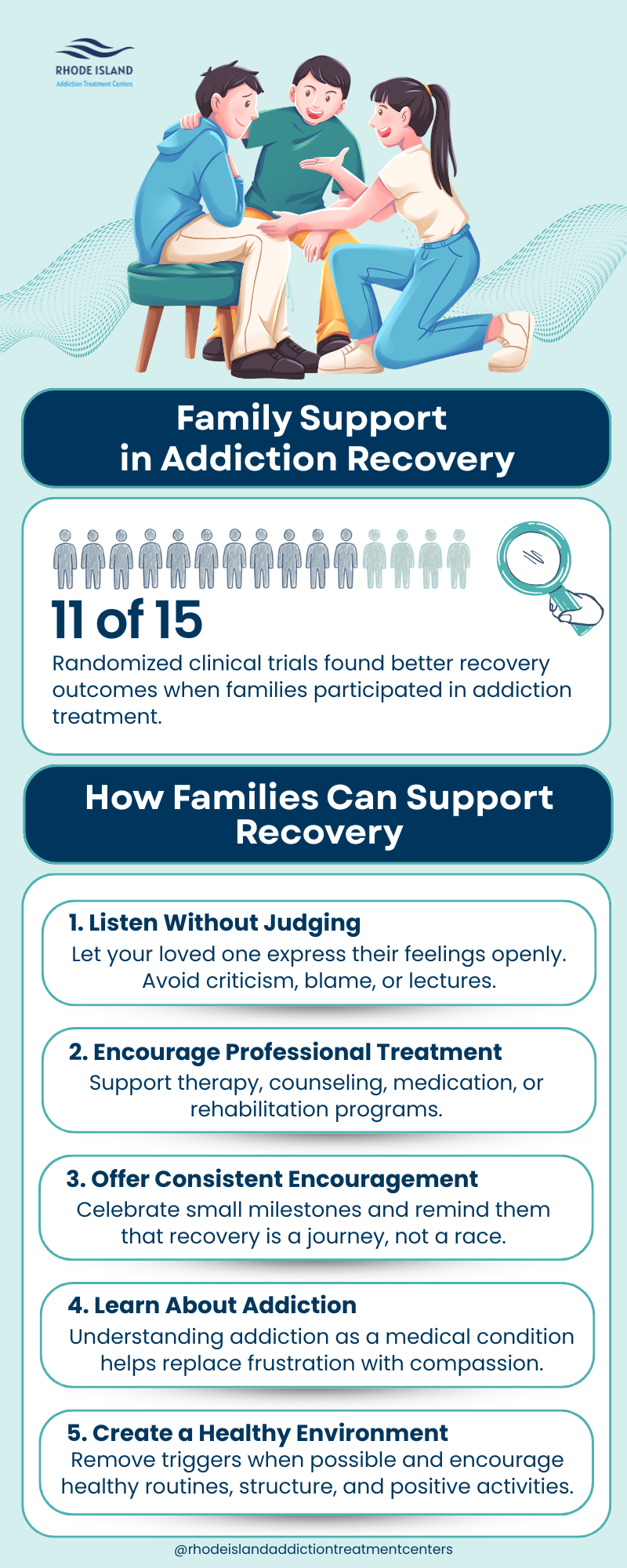
Treatment centers didn’t start including families as an afterthought. In fact, research backs it: families trained in structured support methods see their loved ones enter treatment at nearly double the rate of those who go it alone and stay in recovery significantly longer than loved ones whose families weren’t involved.
Breaks the Isolation
Addiction has a way of shrinking a household down to just the crisis. Conversations stop being about anything else. Friends stop getting invited over. The person using is isolated by the addiction itself, and the people around them get withdrawn by the sheer effort of managing it.
Family involvement in treatment reopens that door in both directions. It gives your loved one somewhere to land besides denial, and it gives you somewhere to put the fear and exhaustion that’s been sitting alone in the house for months.
Improves Treatment Outcomes
This isn’t just a comforting idea; it shows up in the data. Family-based treatment approaches are consistently linked to increased treatment engagement, better completion rates, and lower relapse rates compared to treatment that leaves families out entirely.
One clinical study on structured family coaching found 76.9% of loved ones entered treatment when families were trained and involved, compared to 40% when families relied on peer support alone. It’s not a guarantee, and it doesn’t mean the work falls on you. It means your presence is doing something measurable, even on the days it doesn’t feel like it.
Repairs Trust Over Time
Nobody walks out of treatment and picks up the relationship exactly where it left off. Too much happened for that. Instead, it starts the slower work, the kind that gets rebuilt one honest conversation, one kept promise, and one undramatic weekend at a time.
Families who are involved from early on tend to get there faster, mostly because they’re not starting that work from a complete stop.
Effective Methods Employed In Family Support Programs
Good intentions are easy to come by; effective solutions aren’t. Real progress starts when families lean on proven approaches instead of guessing their way through.
Psychoeducation
The first step in psychoeducation for families is learning about addiction and understanding it as a chronic, relapsing brain disorder rather than a moral failure. Grasping these realities alters the perspective of family members regarding the situation. It shifts the focus away from blame and sets the foundation for therapies like CRAFT, FBT, and MDFT to work effectively.
Community Reinforcement and Family Training
CRAFT flips the usual script. Instead of centering a confrontation, it centers you, your communication patterns, and your responses- the small ways you might be softening the consequences of your loved one’s use without meaning to.
Clinical research puts CRAFT’s success rate at around 74% for getting a resistant loved one into treatment, compared to far lower rates for confrontational interventions. Families trained in CRAFT also report improved communication with their loved one in 95-99% of cases, regardless of whether that loved one enters treatment right away.
Family Behavior Therapy (FBT)
FBT works once your loved one is already engaged in some form of care, pairing them and a family member in joint sessions focused on setting concrete goals, identifying triggers, and rebuilding functional routines together.
It’s listed as an evidence-based practice by SAMHSA and has shown particular strength in improving family functioning and treatment engagement, alongside standard individual therapy.
Multidimensional Family Therapy (MDFT)
MDFT is built specifically for adolescents and young adults, working across several parts of a young person’s life at once. The individual, the parents, the family unit, and outside systems like school. In head-to-head studies, MDFT patients completed treatment at a rate of 90%, compared to 48% in individual therapy alone.
If the person you’re trying to help is a teenager or in their early twenties, this is often the more precisely fitted option.
Rhode Island Resources Families Can Lean On
You don’t have to figure this out with no map. Rhode Island has nonprofit support groups built specifically for families standing where you’re standing.
- RICARES (Rhode Island Communities for Addiction Recovery Efforts) is a 501(c)(3) focused purely on recovery advocacy, peer support groups, and reducing stigma. They don’t provide clinical treatment, but they know how to point families toward what will truly help.
- Parent Support Network of Rhode Island (PSNRI) is a peer-led nonprofit offering family support, parenting classes, and guidance for families navigating a loved one’s substance use. Not medical rehabilitation, but real, lived-experience support.
- BH Link, Rhode Island’s statewide behavioral health crisis hotline and triage center, is available around the clock. It’s often the first call that turns into a plan, routing families and individuals toward independent treatment centers equipped to help.
Also Read: Local Resources in Rhode Island for Family Members of Addicts
Final Words
You’re not required to save anyone by yourself. That was never actually the job. The job is closer to what these programs already do: stay steady, stay present, and hand your loved one a door that stays open even when they’re not ready to walk through it yet.
You don’t have to hold this weight by yourself. Families across Rhode Island are making a difference by choosing effective, evidence-based care. Contact Rhode Island Addiction Treatment Centers now to explore treatment options and start building a path forward.