Navigating Alcohol Relapse Prevention During the Holiday Season in Providence, RI
Hunger can alter how satisfying alcohol is, according to a Brown University study released in October. The researchers worked with fruit flies and traced the effect to a single octopamine neuron that is the fly equivalent of norepinephrine. Flies developed an alcohol preference only when they were hungry. Karla Kaun, who leads the lab, gave the human version: skip lunch, and the bar you pass daily without a glance suddenly catches your eye.
Relapse behaves the same way in one respect: it rarely arrives out of nowhere. In a 2026 Mass General Brigham study, 50 adults who relapsed after anywhere from one to 23 years of remission described risk factors that built up across the preceding year, not overnight.
If you’re in recovery in Providence, the next six weeks stack those factors on purpose. The earliest sunset of the year lands around 4:15 p.m. on December 8. Thanksgiving, office parties, and family dinners all fall in the same stretch. Rhode Island’s alcohol-related death rate was 15.6 per 100,000 in 2024. Let’s explore the evidence on navigating recovery, whether you’re newly sober or long-term.
Factors Associated with Relapse in Alcohol and Substance Use
The Eurasian Journal of Medicine found that craving, comorbid psychiatric disorders, sleep disturbance, negative life events, and low self-efficacy consistently raise relapse rates. Three of these matter most between now and January.
Craving Triggered by Cues and Context
Drinking environments and peer pressure, the exact setting of holiday parties, are well-documented craving triggers. Add the Brown finding, and the picture sharpens: the same cue hits harder when you’re running on an empty stomach.
Mental Health Symptoms, Stress, and Poor Sleep
Kelly et al. (2026) participants identified mental health symptoms as the leading cause of relapse (11 of 50), surpassing reduced focus on recovery (8). Another 2023 review highlights sleep disturbances and negative life events, such as grief, financial issues, and family conflicts, which tend to peak in December. Providence’s shortest day offers about nine hours of daylight, so sleep and mood take a hit just as demands rise.
Thin Support and a Slipping Recovery Routine
Social support is protective, while unsupportive or alcohol-using networks raise risk. Reduced focus on recovery and low energy are the most commonly reported contributors. In Kelly’s study, among factors people rated as definitely contributing, 41 percent were psychological and 30 percent social. The pattern is usually mundane: a skipped meeting, a missed check-in, or a relative’s offer you didn’t rehearse a response to.
Psychotherapies and Medications That Reduce Alcohol Relapse Risk
The National Institute on Drug Abuse places relapse rates for substance use disorders at 40 to 60 percent, comparable to other chronic conditions. That is why treatment plans get adjusted rather than abandoned.
Cognitive-Behavioral and Mindfulness-Based Relapse Prevention
Relapse is a gradual process that unfolds in three stages. Emotional, mental, and physical.
It often begins weeks before a person actually takes a drink. Bargaining, such as persuading yourself that it’s acceptable to make an exception and drink during a holiday or vacation, is a classic warning sign of relapse.
Long-term heavy drinking risk can be considerably decreased by engaging in mindfulness-based relapse prevention, which is usually accomplished through organized weekly group sessions.
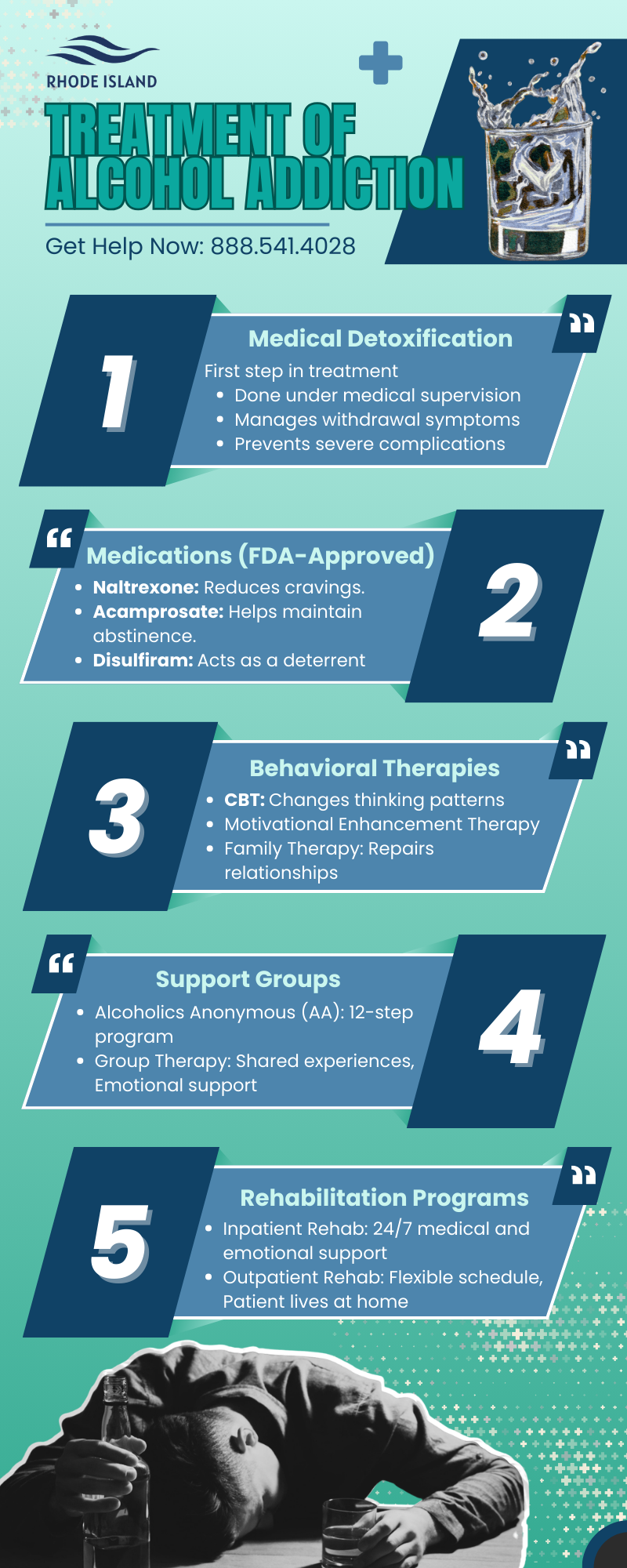
Naltrexone and Acamprosate
Medications like oral naltrexone and acamprosate are commonly prescribed alongside counseling and psychosocial care to support recovery.
These options help reduce cravings and support long-term goals, with neither option showing overwhelming superiority over the other, allowing doctors and patients to tailor choices to individual needs.
Twelve-Step Facilitation and Mutual-Help Groups
The 2020 Cochrane review covered 27 studies and 10,565 people. High-certainty evidence showed that structured twelve-step facilitation produced higher continuous abstinence than other active treatments, including CBT, while performing about equally on other outcomes.
In Providence, find meetings at rhodeisland-aa.org. Online and call-in AA and SMART Recovery meetings also help when snow or a crowded schedule gets in the way.
Holistic Techniques and Home Strategies for Staying Sober Through the Holidays
Navigating the holiday season in recovery takes more than sheer willpower. Rather, it requires proactive, everyday habits that keep your mind and body grounded.
Run a HALT Check Before You Walk Out the Door
HALT stands for hungry, angry, lonely, and tired. Dr. Melemis treats it as a reminder of poor self-care, the common thread of early relapse, and Addiction Center recommends a regular inventory.
The Brown study is its biology: eat before the party, call someone if you’re isolated, and nap if you’re wiped. Fixing the letter often shrinks the craving.
Ground Yourself and Breathe
The 5-4-3-2-1 technique: name five things you see, four things you can touch, three things you hear, two things you smell, and one thing you taste.
Pair with 4×4 breathing: four seconds in, hold, four seconds out. Both take less than a minute, and no one at the table will notice.
Protect Sleep and Daylight
Maintaining consistent habits around sleep, nutrition, and physical activity serves as a vital anchor during the holidays.
According to the New York Office of Addiction Services and Supports, poor eating habits, insomnia, and fatigue act as major early warning signs and triggers for relapse. Establishing a daily routine helps stabilize energy and mood.
Additionally, in December you have about 9 hours of daylight, so get out before the sun goes down.
Build an Exit Plan and a Providence Safety Net
Most physical relapses are “relapses of opportunity,” so practice your exit: your own ride, a drink in hand, a leave-by time. Make an emergency contact list.
Every Providence fire station connects you to peer support 24 hours a day, 7 days a week. BH Link (975 Waterman Ave., East Providence) is open 24 hours a day, and you can call or text 988. In Rhode Island, the Hope & Recovery Support Line is 401-942-STOP (7867).
Final Words
If you want that support close to home, Rhode Island Addiction Treatment Centers in Warwick offers outpatient and intensive outpatient programs, partial hospitalization, CBT, DBT, and co-occurring disorder care for adults, with a program for alcohol addiction. Call 888.541.4028 before the calendar fills up.