
How an Intensive Outpatient Program (IOP) Works for Dual Diagnosis in Warwick, RI
For a long time, treatment for people with both an addiction and a mental health condition worked like a bad airport connection. Sort out the drinking first, then come back for the depression. Or the reverse. Two gates, two lines, one very tired person in the middle.
The Rhode Island Department of Health gave an overdose surge alert last July, when 65 people suffered non-fatal overdoses in emergency rooms in the week, with the highest number being on the Fourth of July. The impact was significant on the people of Warwick, as well as of Providence, Woonsocket, and Pawtucket.
The situation is also skewed across the country. Approximately 21.2 million U.S. adults have had co-occurring mental illness and substance use disorders. Unfortunately, only 14.5% of these received treatment for both, and more than 41% received none of them.
That gap between needing two kinds of care and getting both is the one an intensive outpatient program (IOP) is built to close. Here’s how, one benefit at a time.
First, What Is an IOP?
Having a ‘dual diagnosis’ means that an individual has a substance use disorder and a mental health issue, such as depression, anxiety, PTSD, or bipolar disorder. These tend to feed into each other. For example, someone may feel anxious and want to drink. This affects their sleep and in turn, makes their anxiety worse.
An Intensive Outpatient Program (IOP) is somewhere between weekly therapy and residential treatment. You will attend sessions for several days a week, although they will last a few hours. This should amount to a minimum 9 hours per week. At the end of the session, you will head home to finally get some proper sleep in your bed.
Also Read: How Long Does IOP Last in Rhode Island? A Realistic Timeline
1. One Team, One Plan, Two Conditions
In parallel care, your addiction counselor and your psychiatrist might never exchange a word. You become the messenger, carrying notes between two offices like a very stressed carrier pigeon.
Integrated IOP care means both conditions are on the same treatment plan. At Rhode Island Addiction Treatment Center, our team treats your anxiety and your cravings as one story, not two different files. You say it once, and everyone involved in your care is on the same page, which in healthcare is pretty much a luxury.
2. Your Life Stays Intact
Residential treatment can be exactly right for some people. It can also mean weeks away from your job, your kids, and your dog, who will absolutely take it personally.
IOP lets you keep your routines while you work on changing the parts that aren’t working. Many programs offer daytime or evening schedules, so treatment can fit around work or school instead of replacing them. It also typically costs less than a residential stay, which matters when the bills don’t pause for recovery.
3. Psychiatric Care Is Built In
The part that most people overlook is that treating addiction on its own may leave the underlying mental health issue untreated and waiting for its turn.
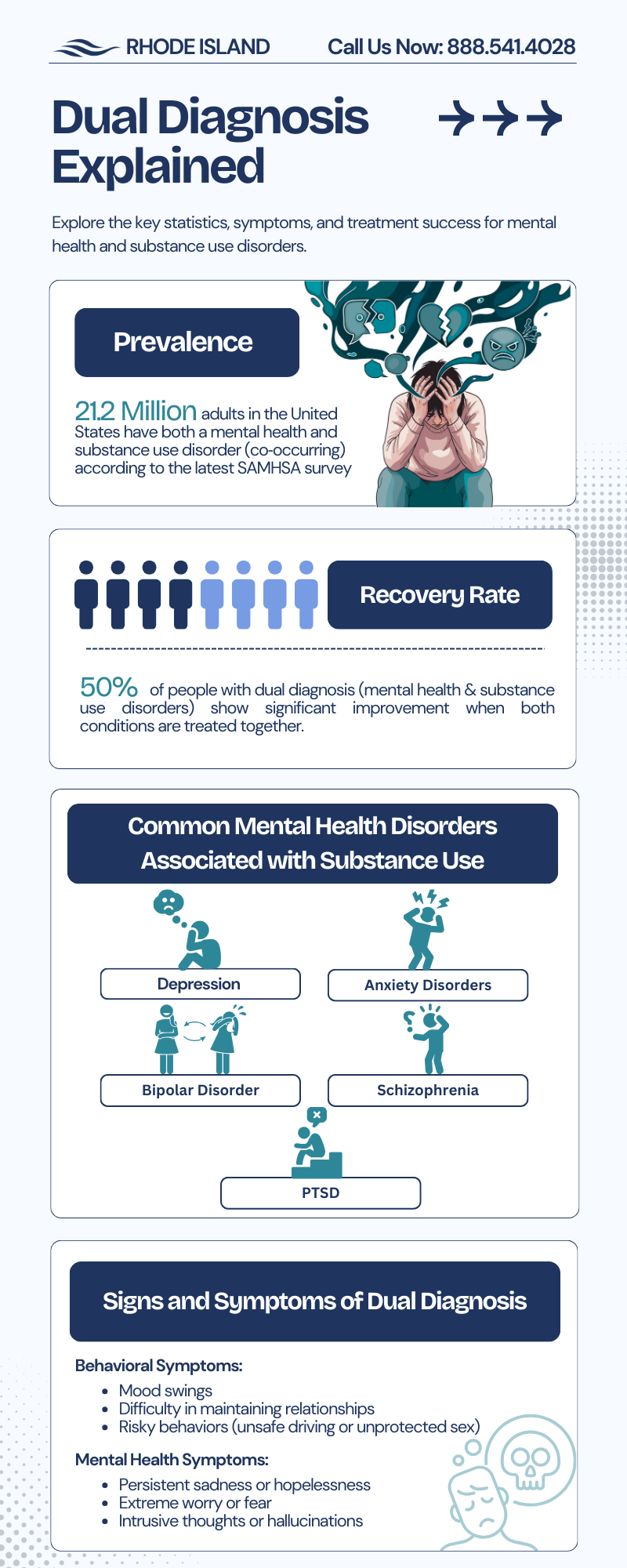
Dual diagnosis IOP typically includes psychiatric evaluation and, where appropriate, medication management alongside therapy. Your depression isn’t treated as a footnote to your drinking. It’s part of the same conversation, with the same urgency.
4. Skills Get Tested in Real Life
Residential programs teach you to cope in a calm, controlled setting. Lovely. But your real triggers live at the office, in the grocery store aisle, and at family dinners.
In an IOP, you learn a tool in group on Monday, try it on a stressful commute Tuesday, and report back on Wednesday how it went. Cognitive behavioral therapy (CBT) and dialectical behavior therapy (DBT) skills, like managing distressing thoughts and riding out intense emotions, get practice where they’ll actually be needed. Think of it as a driving lesson on real roads, not a parking lot.
5. Peers Who Understand Both Halves
Explaining yourself is exhausting. Explaining yourself when your story has two plotlines is a double shift.
Group sessions put you with people who already get it: the panic that comes before the craving, the shame that comes after. No need for backstory. It won’t take the place of therapy, but it does something quietly that therapy can’t do: it makes you feel less like the only one.
6. Intensity That Flexes
The process of recovery is not always linear, and good programs will demonstrate that. Most IOP programs will start intense and then will decrease the intensity when you are more stable. Initially, you can attend several days per week.
This means that the treatment will be customized to your progress. If struggling, there will be structure put in place. However, if you are becoming more stable, there will be less structure, and you will take on more responsibility.
7. Relapse Prevention From Day One
Relapse prevention does not consist of a brochure that is handed out at the door when a person is discharged, along with the parking validation. In IOP, you make your plan during your IOP period when you are in the program. You look for red flags and what your worst moments will be, and you pick who you will call in advance.
Both conditions receive a plan: a mental health relapse and a substance use relapse come hand-in-hand. Moreover, aftercare is discussed early, so the end of the program feels like a handoff, not a cliff.
Is IOP the Right Fit?
IOP is more suitable for individuals with stable housing, some support at home, and who do not require medical detoxification. It is also effective as an aftercare treatment after residential or partial hospitalization treatment.
If you are experiencing severe withdrawal symptoms or an acute psychiatric emergency (e.g., suicidal ideation), you are most likely going to need a higher level of care initially. A good program will tell you so and will help you get there. If you are in crisis at this time, please dial or text 988 to contact the Suicide & Crisis Lifeline.
Final Words
You’ve been handling two problems with one exhausted brain, and nobody ever handed you a medal for it. Dual diagnosis treatment doesn’t ask you to pick a problem and go stand in the correct line. It asks both questions at once, and it lets you go home at night.
Visit rhodeislandaddictiontreatmentcenters.com to explore dual diagnosis IOP options in Warwick and across Rhode Island, and take the first step toward treatment that finally treats both halves of the story.
Read Next: Understanding Fentanyl Overdose Risks and Narcan Access Across Rhode Island