
Blue Cross Blue Shield of Rhode Island: In-Network Detox and Rehab Coverage Explained
Your insurance card has been sitting in your wallet for years, wedged somewhere between a library card and a coffee punch card with one stamp on it. You’ve used it for flu shots and for a sprained ankle. You never read the back. And then someone you love needs detox, and that little piece of plastic feels like the most important document you have.
Take a breath. If you have Blue Cross Blue Shield of Rhode Island (BCBSRI), you probably have more support than you realize. The specifics vary by plan, and the phrase “in-network” is more important than almost anything else. This guide will assist you to understand what BCBSRI covers, what the fine print means, and how to get real answers before you pick up the phone.
Does Blue Cross Blue Shield of Rhode Island Cover Detox and Rehab?
Yes, with a caveat we’ll get to. Rhode Island law requires health plans to cover mental illness and substance use disorders, and both are considered essential health benefits under the Affordable Care Act. BCBSRI’s own medical policy states that annual or lifetime dollar limits cannot be applied to coverage of these conditions. Simply put, nobody can tell you that your treatment “used up” your plan for good.
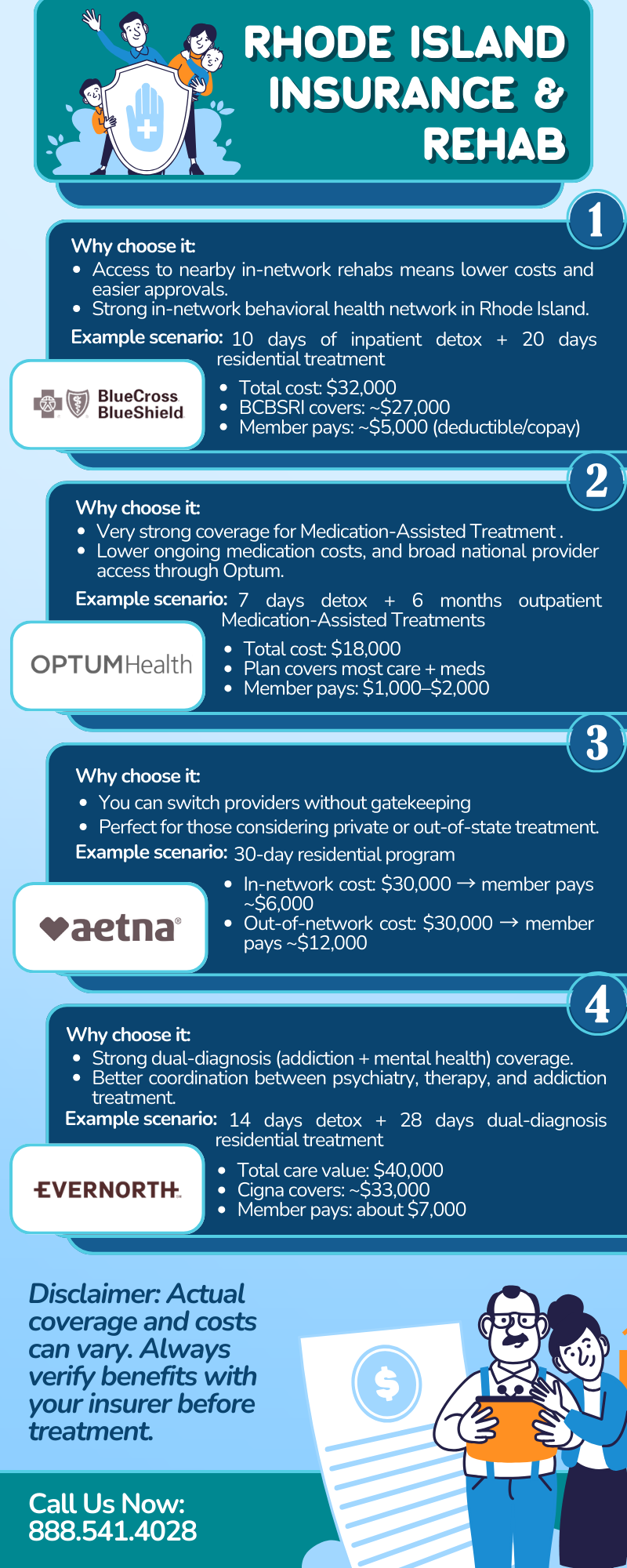
Now the caveat. Covered doesn’t mean free. Your deductible, copays, and coinsurance still apply, and they change from plan to plan. Your Subscriber Agreement spells out what you pay for each level of care, and BCBSRI says as much on its own member page. Think of the law as the floor. Your plan decides how high the ceiling sits.
The Levels of Care Your Plan May Cover
Addiction treatment isn’t one thing. It’s a staircase, and your needs decide where you step on, not your insurance card.
Medical detox, which BCBSRI calls inpatient withdrawal management, comes first for many people. Alcohol, opioid, and benzodiazepine withdrawal can be dangerous without medical supervision, so this step is about safety before anything else. From there, some people move into residential treatment, a 24-hour, non-hospital setting where therapy fills the day while symptoms and cravings settle.
Partial hospitalization and intensive outpatient care are the steps down. BCBSRI says a partial hospitalization program typically is five days a week for about five hours a day. An intensive outpatient program typically meets three times a week for three to four hours, usually for four to six weeks. You are hence allowed to sleep at home and keep a hold on your daily life. Medication-assisted treatment, which combines medication with counseling, is also part of the picture, and BCBSRI care managers can help you find an in-network provider for it.
Standard outpatient therapy and aftercare complete the staircase. You don’t need a referral from your primary care provider for counseling or medication, which removes one barrier at a difficult time.
In-Network vs. Out-of-Network: Why the Difference Matters In Rhode Island
If the facility is In-network with BCBSRI, you will typically have cost savings, fewer surprises on your bill, and an easier process for claims. In contrast, if the facility is out-of-network, then depending on your plan, you may have increased costs.
Many facilities may claim to be in-network with Blue Cross. However, Blue Cross Blue Shield is a group of independent companies. Some may be in-network with one insurer but out-of-network with another. To be certain, ask, “Are you in-network with Blue Cross Blue Shield of Rhode Island under my specific plan?” BCBSRI itself tells members to confirm a provider’s network status before starting care, because networks change.
Your best tool is the Find Care search on bcbsri.com. Your second-best is the facility’s admissions team, who can verify your benefits by phone.
Notices, Approvals, and Who Handles the Paperwork
This is the part that scares people, so let’s make it small. BCBSRI’s provider site says behavioral health inpatient and intermediate levels of care require a notification of admission and discharge. That covers inpatient and residential substance use treatment, inpatient detox, crisis stabilization, and partial hospitalization. In-network facilities send both notices through BCBSRI’s electronic portal, within 48 hours of admission and within 48 hours of discharge.
Who sends them? The facility does. You shouldn’t be filing forms while you’re shaking through withdrawal. Nevertheless, ask admissions one direct question: “Who is handling the BCBSRI notification, and has it been sent?” BCBSRI says the 48-hour window exists to avoid claims issues, so a missed notice is worth catching early.
If you want a person on your side, BCBSRI care managers can help you find services and understand your options. You can reach them at (401) 459-CARE.
Four Calls to Make Before You Commit
- Call the member services number on the back of your card and ask specifically about substance use disorder benefits, not just “mental health.”
- Ask what your plan covers at each level of care: detox, residential, partial hospitalization, and intensive outpatient. Plans can treat each one differently.
- Ask about your deductible, your copay or coinsurance, and your out-of-pocket maximum so the final number never ambushes you.
- Ask the treatment center to run a benefits verification and confirm in writing, or at least by name and date, that they are in-network with your plan.
Where Rhode Island Addiction Treatment Centers Fit In
Rhode Island Addiction Treatment Centers is an outpatient provider in Warwick, about ten minutes from Providence. Its programs for adults 18 and older include partial hospitalization, intensive outpatient, and outpatient care for alcohol, benzodiazepines, cocaine, opioids, and other substances. Detox and residential care happen elsewhere, so this is the step that follows them or the starting point if outpatient care is the right level for you.
Not sure whether your BCBSRI plan covers it? The Verify Insurance form on the center’s website is a simple way to find out before you commit to anything.
Final Words
That card in your wallet isn’t a mystery novel. It’s a phone number, a member ID, and a set of protections your plan has to honor. Read the back. Call the number. Ask the awkward questions about the network, the notices, and the cost. Coverage questions are real, but they shouldn’t be the reason you wait. When you’re ready to take the next step, Rhode Island Addiction Treatment Centers is one call away at 888.541.4028.