Veterans and First Responders Addiction Care: VA Community Care in Rhode Island
Veterans, police officers, firefighters, and paramedics across Rhode Island deal with pressures that most people never see. Repeated exposure to combat and daily life-or-death emergencies takes a real, physical toll on the central nervous system. In 2026, federal VA data showed that roughly twenty percent of veterans diagnosed with Post-Traumatic Stress Disorder (PTSD) also struggle with a co-occurring substance use disorder.
In military and first-responder circles, you are expected to stay composed and push through whatever comes your way. Because of that, it can be hard to admit when alcohol or painkillers have turned into a dependency. However, you do not have to handle this on your own, and you do not have to wait months for an appointment. Through the VA Community Care Network and specialized insurance plans, eligible veterans and first responders can skip long waitlists and start outpatient care right away at Rhode Island Addiction Treatment Centers (RIATC) in Warwick.
Today, let’s talk about how trauma and substance use feed each other, and how you can get started with our team:
Trauma, PTSD, and Substance Use: Getting the Right Care in Rhode Island
Many veterans and first responders in Rhode Island come home from a long shift or a deployment and still cannot switch off. The heart keeps racing, sleep does not come, and a drink or a pill slowly becomes the only thing that takes the edge off. Why does this happen? Well, untreated Post-Traumatic Stress Disorder (PTSD) is a physical injury to the central nervous system. It has nothing to do with a weak character.
At Rhode Island Addiction Treatment Centers (RIATC) in Warwick, we treat trauma and substance use together. Today, let’s talk about how this cycle starts and how veterans can use the VA Community Care Network to get outpatient care with us:
How Trauma Turns Into Self-Medicating
What PTSD Does to Your Nervous System
Repeated exposure to extreme danger keeps the amygdala stuck in a state of chronic hypervigilance. Your internal alarm system keeps flooding your bloodstream with cortisol and adrenaline long after your shift ends or your deployment is over.
The problem is that a nervous system locked in fight or flight loses its natural ability to power down at night. You lie in bed with racing thoughts while your body acts as if the danger is still in the room.
Why Alcohol and Opioids Become the Answer
This is the point where many veterans and first responders start drinking heavily. Alcohol forcefully quiets those racing thoughts and makes sleep possible. Others rely on prescription opioids to numb lingering physical injuries, and over time, the same pills end up numbing deep emotional pain as well.
The GABA and Glutamate Rebound
Here is what happens inside the brain. Alcohol binds to GABA receptors, which temporarily slows down erratic brain activity. However, once the alcohol leaves your bloodstream, the excitatory glutamate receptors overcompensate. That rebound is what triggers the intense panic so many people wake up with the next morning.
Your body slowly adapts to this cycle. Thus, a temporary way of coping turns into a physical dependence, and the substance starts dictating your daily routine.
Why Standard Civilian Treatment Is Not Always Enough
Traditional healthcare settings often alienate people who have served on the front lines. Veterans and first responders tend to hesitate before opening up in standard civilian therapy groups. They worry that the other members, and even the clinicians, will not understand what combat or a gruesome emergency call really looks like.
So, they hold back. They spend a lot of mental energy filtering their stories to protect civilians from the harsh details of their service. The reason this matters is simple; you cannot heal from experiences you are not able to talk about honestly.
Your treatment should respect your background without forcing you to explain basic service culture to the room. Therefore, real recovery requires trauma-informed care from clinicians who respect the moral injuries that come with wearing a uniform. Healing starts when you feel understood and physically safe.
Using the VA Community Care Network (CCN) in Rhode Island
What is the VA Community Care Network?
Federal law is in place specifically to make sure veterans do not suffer because of institutional delays. Under the MISSION Act, the VA Community Care Network allows eligible veterans to receive treatment from approved private providers. If the Providence VA Medical Center has wait times of more than twenty days for behavioral health care, you have the right to seek outside support.
Distance and drive time can also make you eligible for community care. When getting to a federal facility takes too long or is too far to travel, the VA authorizes local treatment options instead. Rhode Island Addiction Treatment Centers is an approved community provider, which means the VA covers the cost of your authorized outpatient program.
How to Get Authorization for Community Care
Dealing with government healthcare paperwork feels overwhelming when you are also managing acute trauma or physical withdrawal. Fortunately, getting authorized comes down to a few straightforward steps.
First, you need to be enrolled in the VA healthcare system and assigned to a primary care team. Next, ask your VA primary care provider for a referral specifically for community-based substance use and mental health treatment.
Once the VA clinical team approves the medical necessity and confirms that you meet the eligibility criteria, they issue an official authorization number. You can then schedule your intake directly at our Warwick facility.
You do not have to figure out this federal paperwork on your own. The admissions directors at RIATC guide veterans and their families through every step of the referral process. We also communicate directly with VA care coordinators to clear up delays and speed up your admission.
Trauma-Informed Outpatient Care at RIATC in Warwick
Stepped-Up Support Through PHP and IOP
For active first responders and working veterans, leaving the family behind for an isolated thirty-day residential stay is rarely practical. Our outpatient programs give you intensive clinical care while you stay in charge of your own day. You attend focused therapy during the day and go home to sleep in your own bed every night.
Our Partial Hospitalization Program (PHP) provides the highest level of daytime support, five days a week, for individuals experiencing acute distress. As your central nervous system stabilizes, you step down into our Intensive Outpatient Program (IOP). The IOP schedule requires fewer hours each week, which allows you to keep your job and take care of things at home while staying on track with your recovery.
Sleeping in your own bed matters here. Protecting your natural sleep environment helps speed up neuroplasticity and memory consolidation. Meanwhile, you get to practice your new emotional regulation skills right in your Rhode Island community, with our clinical team supporting you.
Evidence-Based Therapies for Trauma: CBT and DBT
Our master-level clinicians go further than passive talk therapy and use practical, evidence-based methods. With Cognitive Behavioral Therapy (CBT), we help you safely process and reframe traumatic memories. CBT trains your prefrontal cortex to logically challenge survivor guilt and hypervigilant assumptions.
We also use Dialectical Behavior Therapy (DBT) to build immediate grounding skills. Chronic trauma often triggers sudden panic attacks or intense emotional spikes without any warning. DBT gives you physical tools to regulate your vagus nerve and bring down your resting heart rate in real time.
When something stressful happens on shift or at home, you bring it back to your therapist, and together you make quick adjustments. Over time, you learn reliable ways to manage stress without relying on chemical numbing.
Integrated Dual Diagnosis and MAT Support
Treating substance dependency while ignoring the PTSD underneath leaves your nervous system wide open to relapse. That is why RIATC specializes in integrated Dual Diagnosis care, treating your chemical dependency and your trauma simultaneously, under one roof. Our psychiatric providers and therapists work together every day to stabilize your brain chemistry.
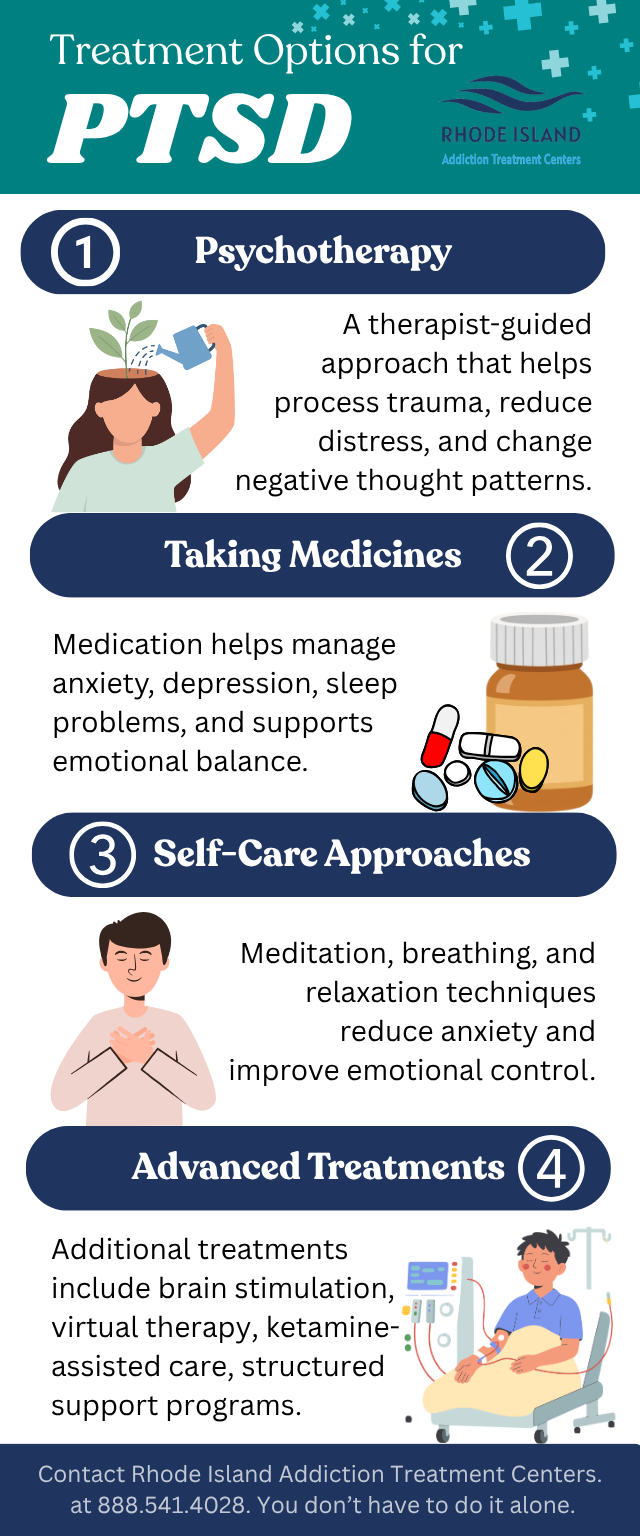
For individuals battling severe opioid or alcohol cravings, we also offer FDA-approved Medication-Assisted Treatment (MAT). Medications like Suboxone or Vivitrol safely occupy brain receptors, which helps ease physical withdrawal and blocks euphoric highs. Once your body is stable, your prefrontal cortex finally has the energy it needs to focus on psychological healing.
Stand Down and Let Us Back You Up
Calling for backup when your unit needs it takes real strength, and choosing trauma-informed care is the most responsible step you can take for your family and your future.
Please reach out to the confidential, judgment-free admissions team at Rhode Island Addiction Treatment Centers today. We will help you sort out your VA Community Care Network authorization, TRICARE, or commercial first-responder insurance benefits so you can get into care quickly.
Contact Rhode Island Addiction Treatment Centers at 110 Jefferson Blvd, Warwick, RI 02888 by calling (888) 541-4028 or visiting rhodeislandaddictiontreatmentcenters.com.
Read Next: Signs a Loved One Needs Inpatient Rehab: A Guide for Rhode Island Families