Addiction Treatment for Veterans in Newport, RI: VA Community Care Explained
Researchers expected that a substance use diagnosis would block veterans from PTSD specialty care. It didn’t. “Based on our study, that does not appear to be the case,” said Alyssa Mansfield, PhD, lead author of a University of North Carolina study of 424,211 veterans with PTSD.
That study found about 16% of those veterans also had a substance use disorder. Roughly one in six. If you’re a veteran in Newport County fighting both battles, you’re far from alone.
So can veterans near Newport use VA benefits for addiction treatment? Yes. You can get care through the VA itself. If you’re eligible and the VA approves it, you may also be able to use a community provider. The VA decides first. Here’s how the pieces fit. You’ll also find what to do if you need help today.
Does the VA Cover Addiction Treatment?
Yes. The VA states that its health care program “covers services to treat substance use problems.” The range of care is wide.
- Medications: Medically managed detox and drugs such as buprenorphine and methadone for opioid addiction.
- Therapy: Short-term and intensive outpatient treatment, plus residential care.
- Relapse prevention: Continuing care and self-help groups.
- Related care: Treatment for PTSD and depression.
To start, talk with your VA primary care provider or call 800-827-1000. No VA health care yet? Combat veterans can get free private counseling and an alcohol and drug assessment at a Vet Center. Homeless or at-risk veterans can call 877-424-3838 for help finding non-VA resources.
What Is VA Community Care and Who Qualifies?
Community Care lets some veterans see providers outside the VA. It isn’t automatic. You must be enrolled in or eligible for VA health care. You generally need approval from your VA team first.
Who Is Eligible?
At least one condition must apply. The VA may not offer the service you need. You and your VA provider may agree that community care serves your best interest. Or the VA may be unable to meet its access standards. For mental health care, those standards are a 30-minute average drive time or a 20-day wait. Urgent or emergency care is an exception to the approval rule.
How Do I Get Approved?
Start with your VA health care team. Ask whether you qualify for community care and whether substance use treatment is covered in your case. The VA’s own community care page doesn’t spell that out. Get the answer in writing if you can. If the VA denies a request, you can appeal through its Clinical Appeals process. The VA reviews denials at the facility level.
Why Treat PTSD and Substance Use Together?
Trauma and substance use feed each other. Alcohol or drugs can numb flashbacks for a night while making sleep and mood worse. Treating only one condition often leaves the other in place.
Sleep is a good example. Drinking to fall asleep wrecks sleep quality. Poor sleep then makes nightmares and irritability worse.
Integrated care breaks that loop from both sides.
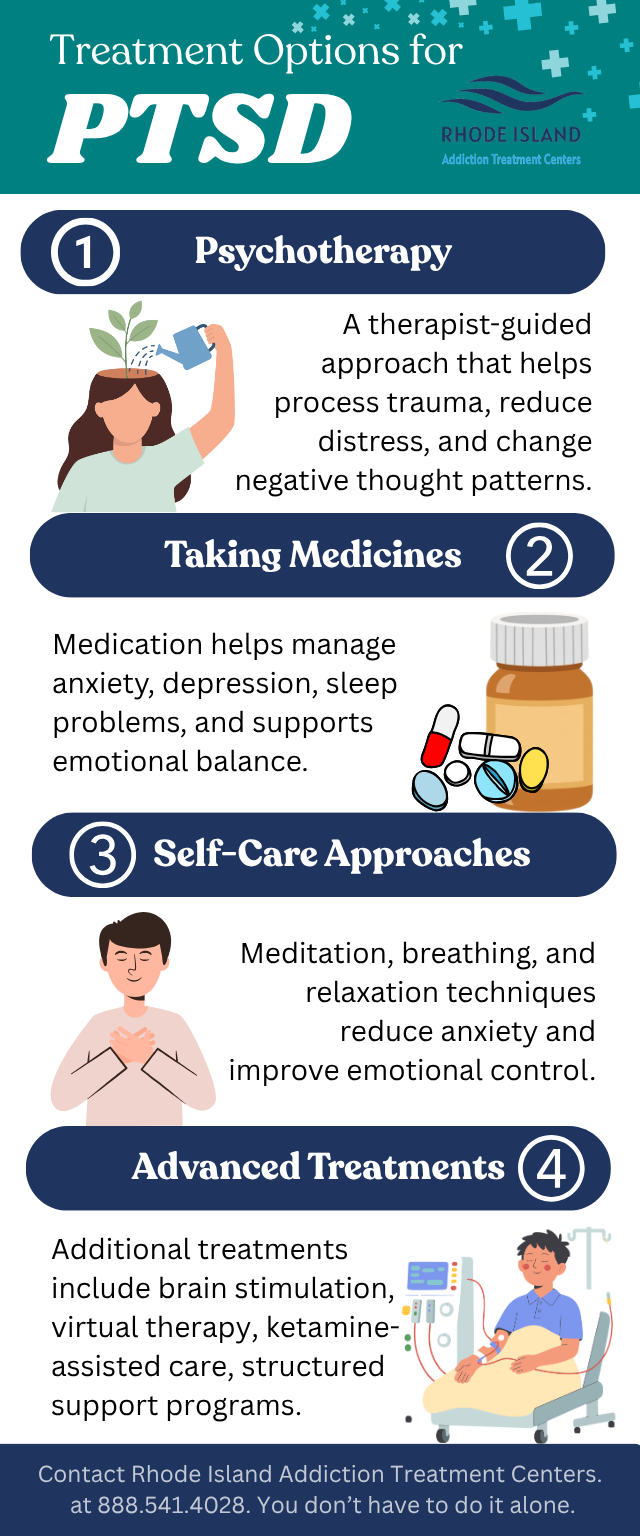
Rhode Island Addiction Treatment Centers’ co-occurring page describes an “integrated treatment model that addresses both mental health and substance use disorders.” Our guide to veterans, addiction and PTSD treatment in Rhode Island explains how TRICARE may apply.
What Does Treatment Look Like for Veterans?
Rhode Island Addiction Treatment Centers treats adults in outpatient and intensive outpatient formats. Its veterans page describes integrated care that may include individual therapy, group counseling, medication management, trauma-focused therapy, and recovery support.
Treatment plans are individualized. That means your plan should reflect your service history, your schedule, and your goals. Tell your clinician about combat exposure, sleep trouble, and anything else weighing on you.
Honest detail leads to a better plan. Our intensive outpatient program page explains how that level of care works.
A Real-World Case: 424,211 Veterans With PTSD
Here’s a large, published snapshot.
Mansfield and colleagues studied veterans with confirmed PTSD who received care at a Veterans Health Administration facility in fiscal years 2009 and 2010. About 16% had a co-occurring substance use disorder. Nearly all had at least one outpatient PTSD visit in the following year. In that year, 43% of veterans with a substance use disorder received PTSD specialty care. Among those without one, 38% did.
The authors had predicted the opposite. They concluded that veterans with both conditions weren’t hindered from receiving specialty PTSD treatment. Mansfield also suggested that starting any VA mental health treatment may help veterans reach PTSD specialty care.
The data are from 2009 and 2010 and cover VA facilities only. They don’t describe community providers. Still, they send a clear message. A substance use diagnosis doesn’t have to close the door.
How Do I Get Started Near Newport?
If you’re in crisis, act now. The Veterans Crisis Line is free, confidential, and open 24/7. Dial 988 then press 1. You can also text 838255. You don’t need to be enrolled in VA benefits to connect.
Rhode Island Addiction Treatment Centers is in Warwick at 110 Jefferson Blvd, Unit G. It serves veterans from Newport and across the state. It doesn’t have a Newport office. Here are your next steps.
- Call your VA team or the Providence VA Medical Center to ask about care.
- Ask any provider you consider whether it’s in the VA Community Care Network.
- Call 888.541.4028 to learn about outpatient and intensive outpatient options.
- Read about our co-occurring disorders program and verify your insurance.
You Served. Now Let Someone Serve You.
You spent years looking out for others. Asking for help isn’t weakness. It’s the next mission. The paperwork can feel like a maze. You don’t have to walk it alone. One call can sort out what your benefits allow. You can also ask a family member to sit in on the conversation, which many people find easier than going it alone.
Ready? Call 888.541.4028 or verify your insurance. Trauma runs deeper for many people than a single cause.
Read our guide to trauma and addiction treatment in Rhode Island. If you’re in crisis, dial 988, then press 1.