
PHP in RI: Intensive Care Without Inpatient Rehab
Just stop your crying; it’s a sign of the times.
You have probably said that to yourself more often than you can count. Not out loud, maybe. A quiet, exhausted instruction directed inward. Stop. Hold it together. Keep going.
And you did. You kept going. That is the part no one sees.
Harry Styles wrote another line in that same song, quieter than the chorus and easy to miss. We don’t talk enough. We should open up before it’s all too much.
For a lot of people who end up calling about a partial hospitalization program in Rhode Island, that line lands somewhere specific. Not because things just fell apart. Instead, things have been quietly falling apart for a long time, and they have been the only ones who knew. Still answering emails. Still picking up the kids. Still doing the visible parts of life.
Day treatment in RI exists for that person. Not only for the most visible crisis. For the quiet one too.
Understanding Day Treatment in Rhode Island
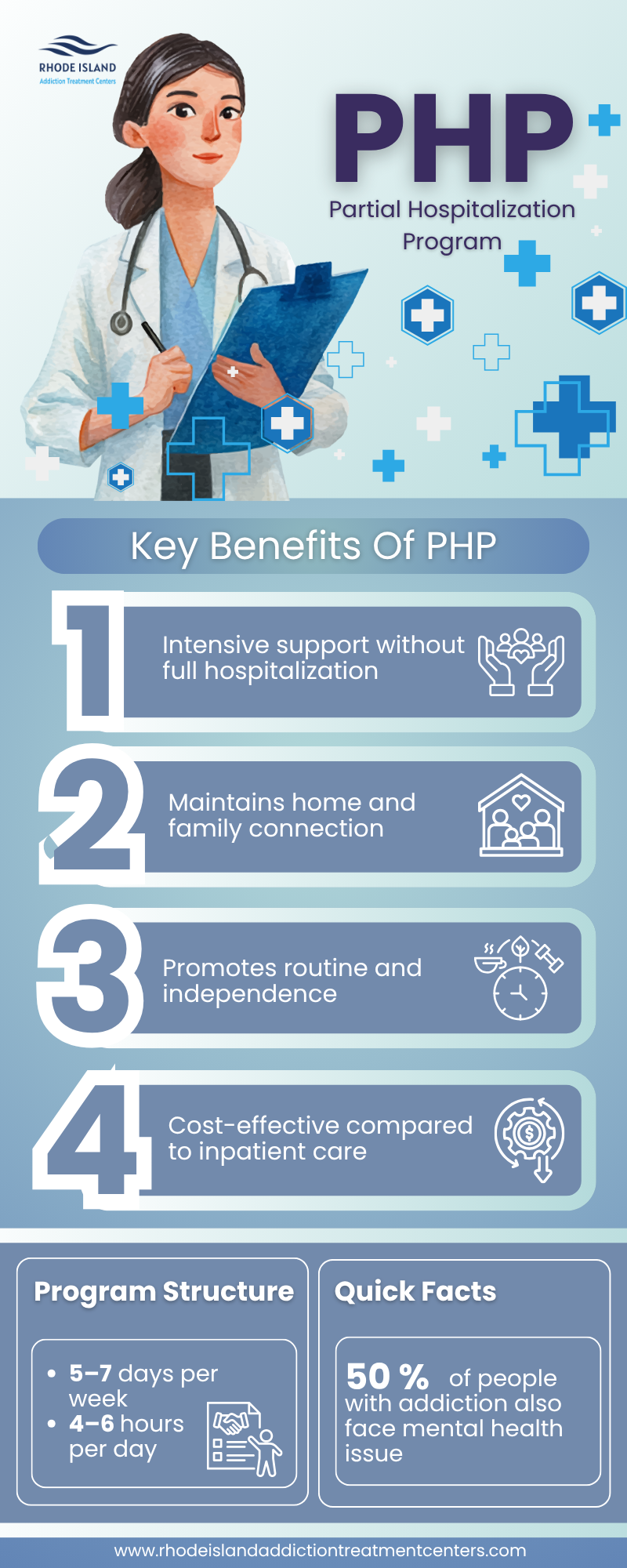
A partial hospitalization program in Rhode Island is not inpatient care. It is not a weekly appointment. It lives between those two things, deliberately.
Most PHP programs run five days a week, four to six hours each day. You arrive in the morning. You do the work. You go home in the evening. That rhythm is not incidental to the treatment. In many ways, it is the treatment. The structure becomes an anchor. The days stop feeling like something to get through and start feeling like something to use.
Group therapy forms the backbone of most days. Not group as a formality, but group as the place where someone else says the thing you thought only you felt, and something in you loosens. Individual sessions run alongside that. A clinician who knows your name, your history, and where you are this particular week. The two work together in a way that neither can fully do alone.
You are not removed from your life during day treatment in RI. You are learning, in real time, with real support, how to live it differently.
The Therapies That Do the Most Work
A good PHP does not apply the same template to everyone who walks through the door. The essential foundation of effective day treatment includes various methods that therapists should learn to operate.
Cognitive Behavioral Therapy explains how your thoughts influence your actions. The method provides you with a structured system to identify your triggers and your negative automatic thoughts. A trained psychologist will then help you replace your faulty coping strategies with healthy and practical ones to restore control over your life. The psychologist and client work mutually to establish their goals and find solutions.
Dialectical Behavior Therapy builds skills in four specific areas: emotional regulation, distress tolerance, mindfulness, and how you move through relationships. It provides a practical solution that people with prolonged high-alert nervous system states can use to develop their skills. DBT gives you something concrete to practice. Not just insight. Tools.
Motivational Interviewing makes space for ambivalence, because ambivalence is almost always part of the picture. Wanting to get better and being terrified of what that requires are not contradictions. They coexist in most people who walk into treatment. Good therapy does not demand that you resolve that tension before you begin. It works with it.
Trauma-informed care is not a single modality. It is a lens. It starts from the recognition that most people who arrive at a PHP carry a history that shaped the present and that real progress cannot happen if that history is treated as background noise.
What to Look for in a PHP in RI
Not every program that uses the words partial hospitalization program in RI is offering the same thing. There are a few things worth paying attention to.
Detailed History and Treatment Plan
A real PHP conducts a real assessment before placing you. Not a ten-minute intake designed to confirm a decision that was already made, but an actual clinical conversation that ends with a recommendation you can understand and ask questions about.
If a program cannot tell you clearly why PHP is the right fit for where you are right now, that is worth noticing.
Do They Treat Co-Occurring Disorders
Ask about dual diagnosis capacity. If a program treats substance use and mental health as separate tracks that do not communicate with each other, it is not built to treat the way most people actually present.
The two are connected more often than not. Your treatment should reflect that.
What’s Their Post-Treatment Plan
Ask about the step-down plan before your first day. A good PHP has already thought about what comes after it.
Transition planning built in from the beginning is not a bonus. It is evidence that a program is thinking about your recovery, not just your enrollment.
Look for Staff Credentials
Inquire about who will be working with you. Credentials matter. So does consistency.
Knowing you will see the same faces and work with the same clinicians across your time in the program matters more than most people anticipate until they are in the middle of it.
The Courage It Takes to Show Up
If we never learn, we’ve been here before.
Why are we always stuck and running from?
A day treatment program in Rhode Island does not require clarity before you arrive. It does not expect you to be further along than you are. It asks only that you show up, and it meets you there each morning, consistently, until something begins to shift.
You kept going when it was hard. When no one could see the effort it took to hold your life together. Showing up here, in a way that is visible and supported, is not a small step. It is the point where repetition can start to break.
That is enough. More than enough.
Rhode Island Addiction Treatment Center uses evidence-based modalities to help you recover from addiction and mental health issues. We exist to assist you throughout your entire recovery process. You can contact us by calling 888.541.4028 or you can complete the form to receive additional information.