
How Blue Cross Blue Shield of Rhode Island Helps Pay for Rehab Treatment
Healthcare has become too expensive in the country. It’s straining our local families, businesses, and our entire state economy. Even with the best efforts to manage costs, the price of medical services and life-saving drugs continues to climb, and people are forced to ignore their health concerns.
At the same time, we’re dealing with something even more urgent: our kids are struggling. Mental health and addiction crises are extreme.
That’s why Blue Cross Blue Shield set a goal to get mental health support to half of all Rhode Island youth by 2025 and is expanding even further now. The company aims to put more resources directly into schools and community groups so kids can get help on time.
This article sheds light on BCBSRI’s efforts to make mental health and drug rehab more accessible. Keep reading!
What Does Blue Cross Blue Shield Rhode Island Do?
Blue Cross Blue Shield of Rhode Island (BCBSRI) is a non-profit company that helps people pay for their doctor visits and hospital stays. Since it is a non-profit, it doesn’t make money for outside investors and uses its earnings to keep its members healthy.
The company works by building an extensive network of doctors and hospitals that agree to charge members lower prices. Once you become a member and visit a doctor in this network, BCBSRI handles the paperwork and pays the doctor directly for their share of the bill. Eventually, a smaller amount goes out of your pocket, and you also get extra benefits like a 24-hour nurse phone line and free exercise classes.
What Types of Rehab does BCBSRI cover?
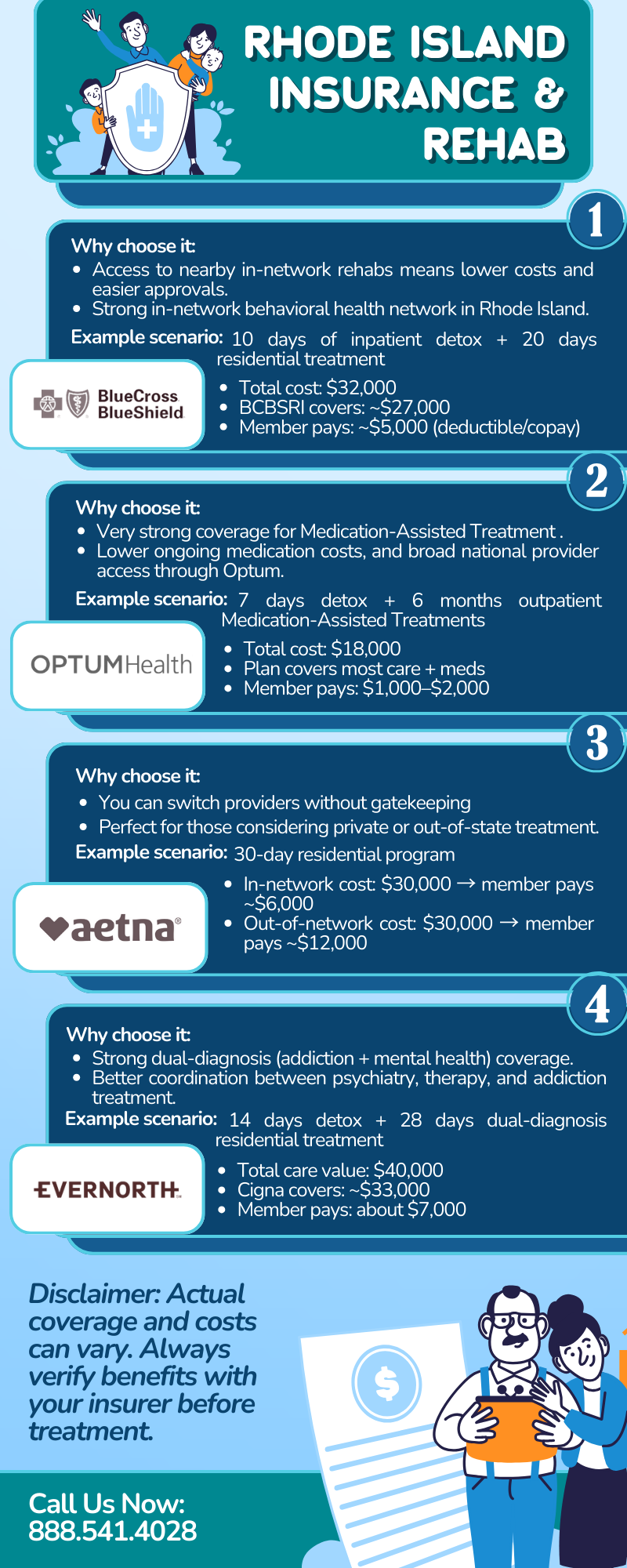
Now comes the big question: Does BCBSRI cover rehab? The good news is, it does. Blue Cross Blue Shield of Rhode Island covers behavioral health treatments, including mental health and substance abuse help.
Here are the stages of alcohol and drug rehab that BCBSRI covers (even if partially):
Rehab isn’t just one thing; it’s a series of steps. BCBSRI typically covers all of these:
Medical Detox
Medical detox is often the most important step in recovery. It is a short stay (mostly a few days) where you safely clear drugs or alcohol from your body while doctors and nurses watch over you.
BCBSRI generally covers this as it is considered a medical necessity. Your BCBSRI insurance will help pay for your room, 24/7 medical care, and some medicines needed to make withdrawal safer and more comfortable.
However, it’s not 100% free, and you will still have to pay your deductible (the amount you pay each year) or a copay (a flat fee for the rehab center stay).
Residential Rehab
A rehab center admits you to an inpatient or residential program when you need a safe environment away from triggers. You essentially live at a treatment facility 24/7 for 30 to 90 days. BCBSRI covers this treatment when a doctor confirms that a less restrictive setting wouldn’t help you recover.
The Blue Cross Blue Shield insurance will help cover your room and board, one-on-one and group therapy, and medical management by on-site staff.
However, it’s worth noting that BCBSRI may require a pre-authorization (medical necessity review) before you can be admitted. Also, since these stays are longer, your out-of-pocket costs will depend on whether the facility is in-network and what your plan’s specific coinsurance rate is.
Partial Hospitalization (PHP)
A Partial Hospitalization Program (PHP) is called day treatment, a middle ground between inpatient and outpatient rehab. During this treatment, you visit the rehab center 5 days a week and spend a few hours there each day. But you don’t live there, nor do you visit it once a week like an outpatient model. BCBSRI supports PHP and covers for your group therapy, counseling, and meetings with a psychiatrist.
Intensive Outpatient (IOP)
An Intensive Outpatient Program is recommended when you need regular support but also need to keep up with your daily life. In an IOP, you attend therapy for about 3 to 4 hours a day, 3 days a week. It’s acknowledged as a step-down from PHP, and BCBSRI covers a part of its 1-1 therapy sessions and even family sessions. Note that since you aren’t at a facility all day, your out-of-pocket costs are much lower than PHP.
Medication-Assisted Treatment
MAT combines FDA-approved medications with counseling and behavioral therapy to help the patient quit faster. It is mostly used to treat opioid addiction (like heroin or prescription pain pills) and alcohol.
BCBSRI covers MAT medications such as Suboxone (buprenorphine), Vivitrol (naltrexone), and Methadone. Many of these medications are listed as preferred on BCBSRI’s drug list, which means they are easier to access and may have lower copays.
But know that even though the medication is covered under your pharmacy benefits, the doctor visits fall under your medical or behavioral health benefits. Because MAT can be a long-term part of recovery, it is important to check if your specific plan has “dispensing limits” (how much you can get at once) or if your doctor needs to stay in-network to keep your costs down.
Rehab is the Best Investment You’ll Ever Make
The bill shouldn’t stop your recovery, and BCBSRI is doing good work in that aspect. Sure, it doesn’t pay for everything (like private luxury suites or long-term sober living houses), but it does cover the medical and therapeutic care that saves lives.
If you want to get better without fear of fees, call BCBSRI Behavioral Health Line at 1-855-931-4985. This is a confidential line where a local specialist can look at your plan, tell you what you’ll owe, and even help you find an open bed in an in-network facility. Rehab is manageable and not so hard on the pocket either when you know who to talk to. So stop delaying and prioritize yourself!