
Why Long-Term Residential Treatment Works for Chronic Relapse
“Long-Term Change Happens When You Give Recovery Enough Time To Work.”
When you are looking to find Long-Term Residential Addiction Treatment in Rhode Island, you or your loved one is probably searching for a quick reset and feel-good again; but what you really need is stability and daily support.
NIDA notes that treatment options for fewer than 90 days generally have limited effectiveness, while stronger results are associated with more extended care. That is what long-term residential treatment does offer: a live-in environment with structure, therapy, and regular accountability.
In this guide, you’ll find out who long-term care can help most, what day-to-day life actually looks like, how step-down planning takes place — and how to select the right program.
What Long-Term Residential Addiction Treatment In Rhode Island Means
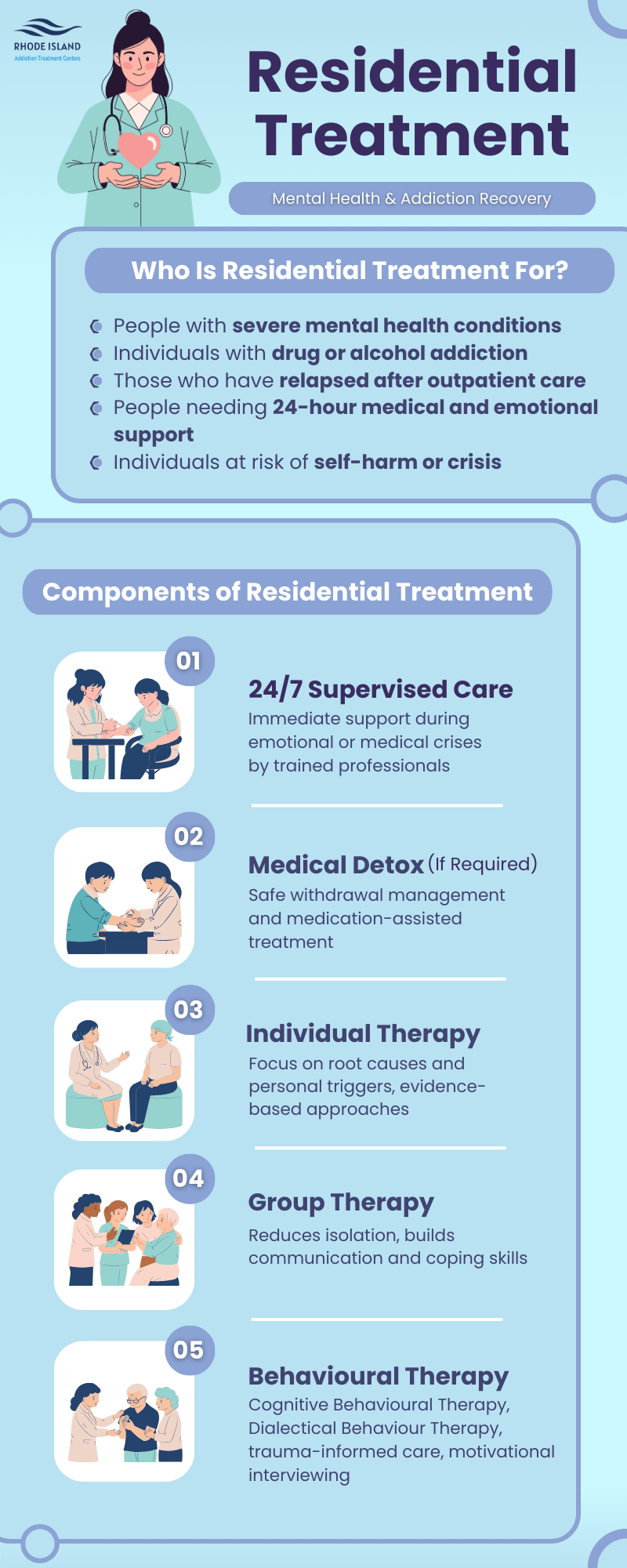
At Rhode Island Addiction Treatment Center, Long-Term Residential Addiction Treatment in Rhode Island means living on-site in a structured environment with 24/7 support for an extended period, often 90 days to 12 months or longer. This kind of care gives you space away from triggers, while you rebuild daily habits with steady clinical guidance.
The goal is deeper change, not a quick pause. You work on the roots of addiction, practice recovery skills daily, and build a realistic plan for aftercare planning so progress continues after discharge.
Long-Term Vs. Short-Term: Why Duration Matters
- Short-term (often 30 days): stabilization, withdrawal support, and basic coping tools.
- Long-term: stronger relapse prevention, deeper behavior change, and more time to practice healthy routines before returning to daily stress.
Who Long-Term Residential Addiction Treatment In Rhode Island Can Help
Long-Term Residential Addiction Treatment in Rhode Island often fits people who have struggled for years, relapsed after shorter programs, or feel stuck in a cycle they cannot break at home. It can also help when a person needs time to rebuild health, restore focus, and learn stability before stepping back into work, family, and responsibilities.
Suitability matters a lot, so we look at your full situation. The right Long-Term Residential Treatment Center in Rhode Island matches the substance involved, your medical needs, your mental health needs, and the type of support you can realistically access after discharge.
Common Conditions And Patterns Treated
- Polysubstance use (more than one substance).
- Opioid or alcohol dependence with repeated relapse.
- Dual diagnosis needs, such as anxiety, depression, or PTSD, alongside addiction.
- A history of treatment attempts that did not “stick” once you returned home.
Signs You May Need Long-Term Residential Care
- Addiction has lasted years, with repeated relapses.
- Daily functioning is impaired (sleep, hygiene, work, school, relationships).
- Your environment keeps pulling you back into use.
- Mental health symptoms make recovery harder without a steady structure.
What To Expect In Long-Term Residential Addiction Treatment In Rhode Island
In Long-Term Residential Addiction Treatment in Rhode Island, the initial phase is an all-inclusive intake assessment, which helps develop your unique plan. From there, treatment is often broken down into stages — stabilization, acquiring skills, taking on more responsibility, and preparing for re-entry — so that progress feels gradual rather than haphazard.
Routine is one of the greatest things about long-term care. You receive therapy, group support, and regular practice in a safer environment, through which you start to develop confidence gradually, so that you have less chaos from addiction.
Core Components Of A Therapeutic Community Program
Many long-term programs use a therapeutic community approach, where recovery happens through shared structure and peer support.
- Group living with shared expectations and accountability.
- Individual therapy and group therapy for insight and skill practice.
- Education, life skills, and vocational support when available.
- House meetings, chores, and gradual leadership roles.
A Typical Day (Sample Schedule)
- Morning: Wellness routine, check-in, and goal setting.
- Day: Therapy sessions, skill groups, education, work, or training blocks.
- Evening: Peer support, reflection time, and healthy downtime.
The Process: Detox, Rehabilitation, And Aftercare In Long-Term Residential Treatment
Many people start with medical detox, then move into rehabilitation once withdrawal symptoms are stable. Detox often takes days to a couple of weeks, while rehabilitation is the longer phase where habits, thinking patterns, and coping strategies are rebuilt with structure and repetition.
Just as important, long-term care should never end with “good luck.” Strong programs build aftercare planning early, including follow-up therapy, step-down care, support meetings, and practical life planning, so you do not leave with unanswered questions.
Why 90+ Days Makes A Difference
NIDA explains that staying in treatment long enough matters, and that treatment participation for less than 90 days is often of limited effectiveness, while longer treatment is recommended.
This is one reason long-term residential care can be a better fit when addiction has been severe, long-lasting, or tied to complex life stress.
Levels Of Care And Step-Down After Long-Term Residential Treatment In Rhode Island
A strong long-term program prepares you to step down gradually, not suddenly. That matters because relapse risk often rises during major transitions, so the goal is to reduce intensity slowly while keeping support consistent.
After Long-Term Residential Addiction Treatment in Rhode Island, many people move through options like PHP, IOP, outpatient therapy, and sometimes sober living. This creates a bridge from full structure to real-world independence, with support still in place.
Level Of Care | Where You Live | Structure Level | Main Focus |
Long-Term Residential | On-site | Highest | Stability, behavior change, daily recovery skills |
PHP | At home | High | Daytime therapy, strong routine, continued monitoring |
IOP | At home | Medium | Skills practice while returning to responsibilities |
Outpatient | At home | Lower | Ongoing support, maintenance, growth planning |
Sober Living (When Needed) | Supportive housing | Varies | Safe environment, accountability, community support |
Partial Hospitalization Program (PHP)
PHP offers intensive daytime treatment while you sleep at home. It helps many people keep structure while they restart daily routines.
Intensive Outpatient Program (IOP)
IOP usually meets several days per week for a few hours. It supports real-world practice while keeping therapy and accountability consistent.
Types Of Long-Term Residential Programs (Choose Wisely)
Long-term residential care is not one single format, so choosing wisely can improve comfort and outcomes. Some programs focus strongly on community-based change, while others provide more clinical intensity, and many offer specialized tracks for specific needs.
For example, a therapeutic community model can be ideal for rebuilding life structure and social stability, while a more clinical track may fit people who need stronger psychiatric support. Matching the program to your needs is often as important as the length of stay.
Therapeutic Community Model
In a therapeutic community, residents learn through routine, peer feedback, and shared responsibility, with roles evolving over time.
Clinical Residential Programs
Clinical residential programs may include more intensive therapy scheduling and stronger psychiatric and medication services, especially when dual diagnosis care is needed.
 For more detail on higher-structure care, read our latest blog, “Inpatient Rehab For Substance Abuse In RI”, to see how inpatient treatment can support and strengthen the path into long-term residential recovery.
How To Choose Long-Term Residential Addiction Treatment In Rhode Island