
Why Some People Finally Quit Drinking After Years of Trying
Alcohol addiction can have long-term negative consequences because of how it affects your body and brain. According to the Royal College of Psychiatrists (RC Psych), alcohol alters two vital chemicals in the brain, GABA and Glutamate. To understand what this means in the context of alcoholism, first you need to see how these chemicals work.
- GABA: This neurotransmitter calms your brain and body. If you drink alcohol, it will increase this chemical’s ‘calming effect and make you slower or less alert.
- Glutamate: Glutamate does the opposite of GABA: its role is to stimulate your brain and body, so when you consume alcohol, it decreases this effect, making you slower.
All in all, alcohol addiction slows your senses, and you feel unprepared or not alert enough to make certain decisions. Slowly, that apparently calm sense takes over, and you could lose your willpower to decide, act, or follow through.
Owing to these consequences that slowly worsen, alcohol addiction treatment in Rhode Island is truly inevitable if you’re a heavy drinker. Since alcohol rehab uses evidence-based therapies to break this addiction, it can improve much beyond the addiction part. It could teach you about your triggers and underlying causes that are boosting this addiction.
That’s why today we’ll talk about the main therapies (sometimes also referred to as modalities in treatment language) used for alcohol addiction treatment in Rhode Island. Keep reading and see how it will go.
Therapies Used for Alcohol Addiction Treatment in Rhode Island
Cognitive Behavioral Therapy (CBT)
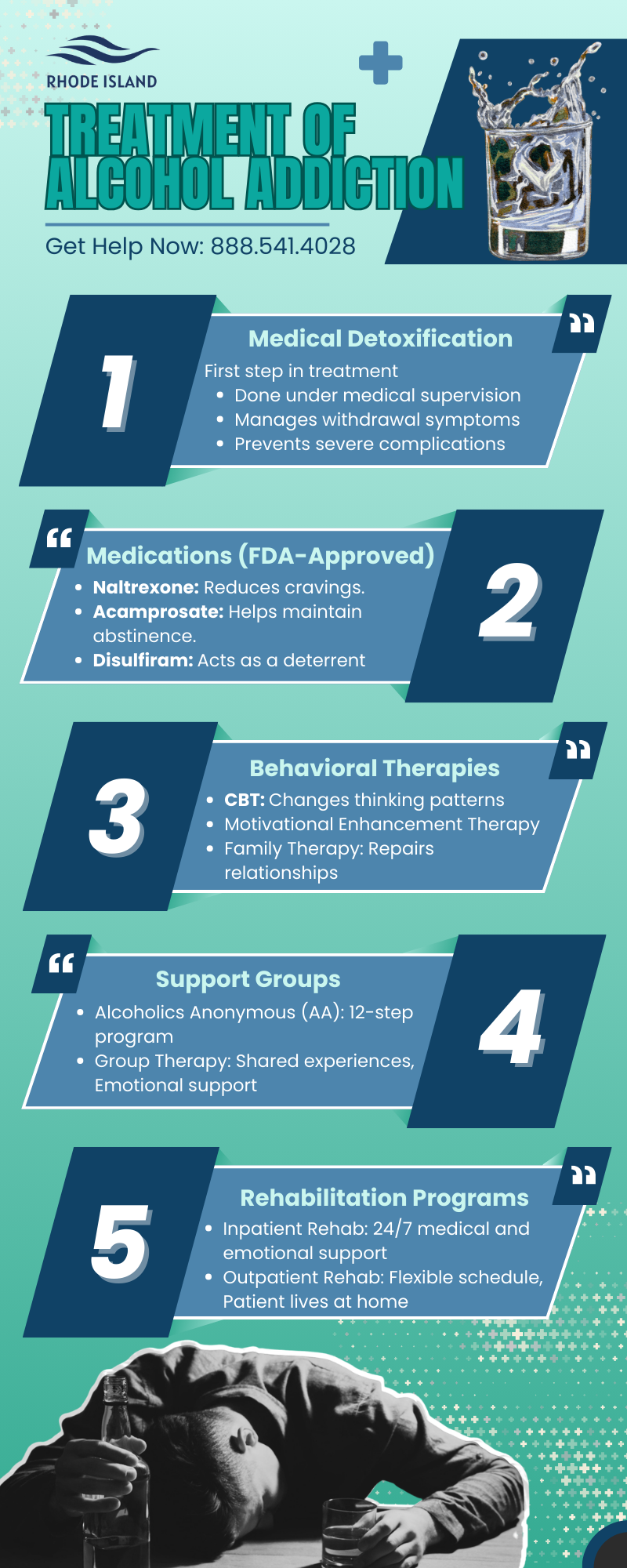
CBT is a structured talk therapy meant to help patients identify how their thoughts and beliefs contribute to addiction. It’s the most focused approach during alcohol addiction treatment in Rhode Island because most people aren’t drinking randomly; something triggers it, and we need to know that. Once a therapist or counselor understands why you started and stuck to alcohol consumption, they can reform your treatment efforts.
Once the triggers are clear, CBT trains you to build an alternative response to them. Put simply, if a fight with your spouse would earlier mean you gobble down a big drink, you’ll train to try a different distraction. The said distraction could be spending quiet time, cooking something, cleaning a place in the house, or simply stepping away for a while. Eventually, if you keep repeating these alternatives you learn during CBT, practising them becomes your second nature, and you can better control the cravings.
Besides, CBT fixes those thinking patterns that make quitting feel impossible. If you have assumptions like “I’ll never be able to stop” or “one drink won’t hurt,” you’ll learn that they aren’t true and you can challenge them.
Motivational Interviewing (MI)
Motivational interviewing is a conversational therapy technique to help people develop motivation for change. Since addiction can make you feel a certain resistance that you shouldn’t do this ‘difficult’ thing, MI makes you see beyond that.
Its core idea is that people change faster (and more permanently) when the motivation comes from within instead of external factors. That’s why, during MI sessions, the therapist asks you open questions like ” What does drinking cost you?”, or “What would your life look like without this addiction”? As the patient talks and answers these questions, they begin to hear their own reasons for wanting things to be different. Then, the therapist reflects those reasons back and builds a plan for alcohol addiction treatment in Rhode Island based on them.
Another major part of MI is dealing with ambivalence because a big percentage of people entering rehab aren’t fully sure they want to quit. They might want to drink less, but not necessarily give it up entirely. That’s why the therapist helps the person look honestly at both sides during MI until the reasons to change start outweighing the reasons to stay stuck. Eventually, they see the brighter side that lies after rehab completion and feel more focused on a thorough recovery instead of doing ‘just enough’.
Dialectical Behavior Therapy (DBT)
DBT is a skill-based treatment whose goal is to help patients overcome painful emotions. It also works on decreasing conflict in one’s relationships through mindfulness, emotional regulation, and interpersonal communication.
When someone feels things intensely and struggles to cope, therapists introduce them to DBT during rehab or outpatient treatment. As mentioned earlier, it’s based around a few skillsets that collectively improve your alcohol dependence. Here is a brief look at how these skillsets work:
Mindfulness helps one notice what they’re feeling without immediately acting on it.
- Distress tolerance gives you certain tools to survive a craving.
- Emotion regulation helps you understand your emotional patterns so you don’t get overwhelmed as often.
- Interpersonal efforts focus on communication, boundaries, and relationships. Since these areas take serious damage during active drinking, you can slowly rebuild them with the help of DBT.
A big reason that DBT works in rehab is its practicality. Since people learn solid techniques and practice using them, they can experience better recovery. So if a trigger hits them, they already know what to do instead of defaulting to drinking.
DBT also validates a patient’s pain while still positively pushing them to change their behavior. That combination matters because people in early recovery often feel misunderstood. So when they feel heard while also being held accountable, it does a lot of healing work.
You’re Worth Quality Treatment
An addiction can attack even the strongest people; your willpower or self-control doesn’t have anything to do with it. And once this evil catches you and starts damaging your life, seek help at the earliest.
Alcohol addiction treatment in Rhode Island is meant to revive your life and give you control back instead of letting addiction hold you down. Rhode Island Addiction Treatment Center is right here with you every step of the way, so don’t let this thing weigh you down. Let’s figure a way out of it together!