Does Insurance Cover Addiction Treatment In Rhode Island?
In many cases, yes. Rhode Island law says group health plans and individual or group insurance plans must cover treatment for mental health and substance use disorders under the same terms and conditions used for other illnesses and diseases.
That rule matters because it helps stop insurers from treating addiction care like an afterthought. It also gives patients and providers something concrete to point to when a medically needed service is delayed, limited, or denied.
Rhode Island Parity Law
Rhode Island General Laws § 27-38.2-1 states that insurance plans must cover mental health and substance use disorder treatment under the same terms and conditions as other illnesses and diseases. In short, addiction treatment is not supposed to be treated as second-class care.
Medicaid And Other Coverage Options
HealthSource RI says Medicaid offers free or low-cost health coverage for people with limited income and resources, and Rhode Islanders apply through HealthSource RI to learn whether they qualify for Medicaid or a marketplace plan.
American Addiction Centers also notes that both private insurance and public insurance, including Medicaid and Medicare, often cover substance use services when they are medically necessary.
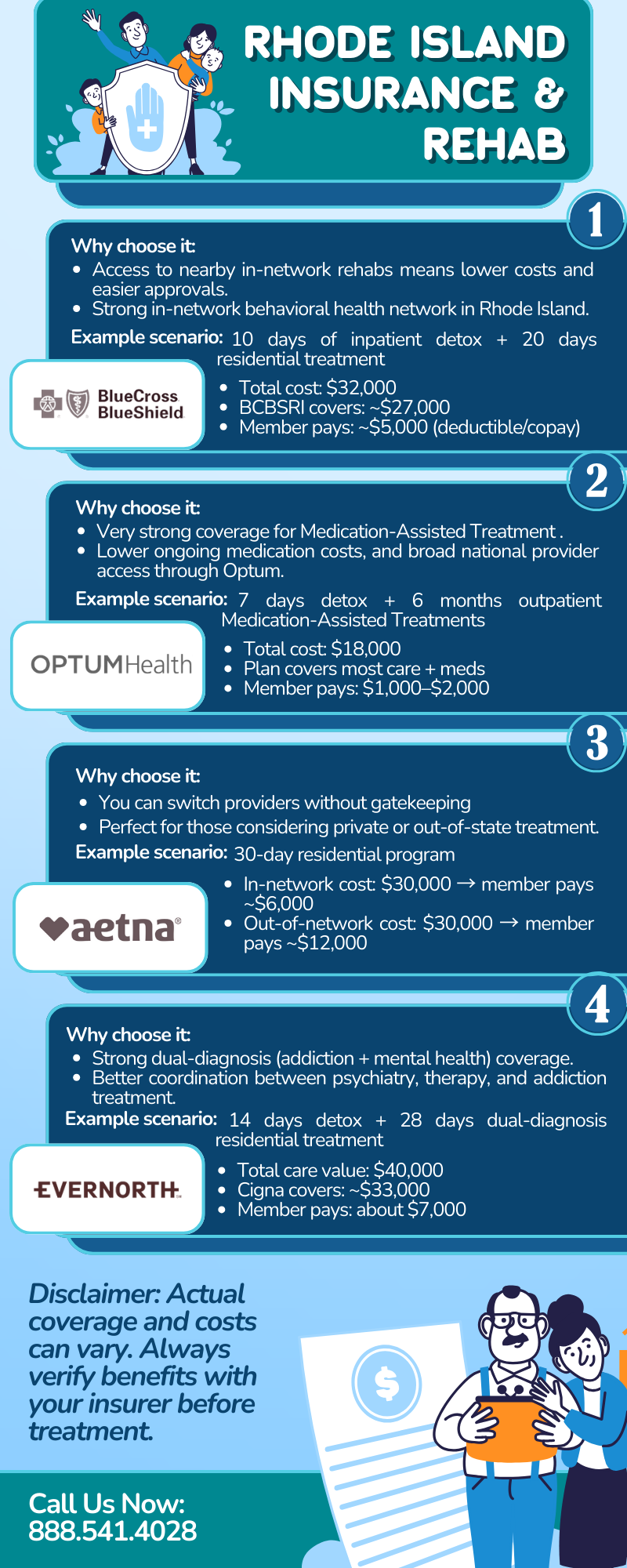
That does not mean every plan covers every program the same way. Deductibles, copays, networks, and pre-authorization rules can still affect what you pay out of pocket.
 If you are weighing treatment costs and care options, read our latest blog: “Free Vs Private Rehab In Rhode Island: What’s The Difference For Your Recovery?” for a clearer view of which path may fit your recovery needs.
Cast Study: Rhode Island Opioid Settlement And Treatment Access
Rhode Island’s opioid-settlement funding offers a real example of how public money can widen treatment access. In June 2024, the Rhode Island Foundation and EOHHS awarded $1.3 million to 20 nonprofits using settlement dollars, with grants focused on basic needs, family support, and trauma support.
A later grant round made another $2.475 million available for opioid-abatement work, including treatment, recovery, and prevention services. That matters because cost is not only about the price of rehab itself. It is also about housing help, peer support, and medication access.
A Boston Fed study adds context here: Rhode Island’s MAT rate effectively doubled between 2012 and 2018, with Medicaid playing a major role in helping people reach care.
What The Funding Looks Like
On June 12, 2024, the Rhode Island Foundation, working with the Executive Office of Health and Human Services, announced $1.3 million in grants to 20 nonprofits using opioid-settlement funds. Those grants were awarded in three categories: basic needs support, family support, and trauma support.
In a later round, the Foundation said $2,475,000 in settlement funding was being made available in four categories, again focused on opioid abatement and recovery work. The same grant page says all of the funds must be directed to opioid abatement, including prevention, intervention, treatment, and recovery.
Why It Matters For Cost
Public coverage and public funding can change access in a real way. A Boston Fed analysis found that the medication-assisted treatment rate per 100,000 Medicaid enrollees in Rhode Island effectively doubled between 2012 and 2018, and more than 80% of first-time 2014 MAT recipients in the study were Medicaid enrollees.
That does not mean every treatment bill disappears. It does mean that state funding, Medicaid, and settlement-backed support can lower barriers and help more people reach medication and recovery services.
Hidden Costs Vs Long-Term Savings
Sticker price is not always the full price. One published cost guide says some rehab centers charge admission fees close to $3,000 or $4,000, and longer stays can raise the final total fast.
At the same time, picking the cheapest option is not always the smartest option. American Addiction Centers says it may not be the best time to focus only on cost-cutting when quality treatment is needed, because the right level of care matters more than the lowest number on the page.
Affordable Options: Low-Cost And Free Rehab In Rhode Island
If private rehab feels out of reach, that does not mean you are out of options. Cost guides note that state-run facilities may provide treatment for free, though they may also have longer wait times and fewer program options than private facilities.
That tradeoff is worth understanding. A lower-cost program can still be a strong first step, especially if it gets you into detox, medication support, or outpatient care without delay.
Where To Start
- Medicaid: Apply through HealthSource RI to see if you qualify for free or low-cost coverage.
- State-Funded Programs: Publicly funded programs may reduce or remove treatment costs for eligible people.
- RI Hope & Recovery Hotline: Recovery Friendly Rhode Island lists the RI Hope & Recovery Hotline at 401-942-7867, and BHDDH says the line is used to screen people for financial-support eligibility and placement into state-funded certified recovery housing.
The hotline is tied specifically to recovery housing support, not every rehab admission in the state.
Even so, it can be a useful point of contact when you need help finding state-funded recovery support and do not know where to begin.
Conclusion: Your Health Is Worth The Investment
Addiction treatment in Rhode Island can cost very little, or it can cost a great deal. The final number depends on the level of care, your insurance, your medical needs, and how long treatment lasts.
Still, cost should not be the only thing driving the decision. The right program is the one that matches your needs, gives you a fair chance to stay in care, and helps you build a life that feels steady again.
If you are weighing your options, start with two practical steps. First, check your insurance through HealthSource RI or your treatment provider, and second, ask a center to explain your likely out-of-pocket costs before admission.
Rhode Island Addiction Treatment Centers can help you verify insurance and talk through which level of care makes sense for your situation.
FAQs
How much is a 30-day program in Rhode Island?
Published cost guides say a 30-day inpatient program often ranges from about $5,000 to $20,000, with an average near $12,500, while Rhode Island residential averages are published much higher because those state averages reflect broader residential episodes rather than one simple flat 30-day price.
Can I get treatment without insurance in Rhode Island?
Yes. State-run facilities may provide treatment for free, and HealthSource RI says Rhode Islanders can apply to see whether they qualify for Medicaid, which offers free or low-cost coverage for eligible residents.
What is the cheapest way to start recovery?
Standard outpatient care is usually the lowest-cost formal treatment option, and Rhode Island’s published outpatient average is about $1,673 per episode, though free or state-funded programs may cost less for eligible clients.
What should I do next?
Check your plan details through HealthSource RI if you need coverage, or ask a treatment center to verify your benefits and walk you through deductibles, copays, and pre-authorization before you commit.