
Residential Addiction Treatment In Rhode Island: What It Offers, Who Benefits, And Next Steps After Rehab
“The opposite of addiction is not sobriety. It’s connection.”
As Johann Hari said in his TED Talk.
But numbers tell a grim story: only 10% of the 2.5 million Americans with opioid use disorder get any sort of specialty treatment in any given year.
Residential Addiction Treatment at Rhode Island Addiction Treatment Centers offers adults a structured, substance-free environment where Individual Counseling, Group Counseling, and life skills training rebuild daily patterns during 30-90 day stays. This is the best approach for complicated cases with Co-Occurring Disorders or frequent relapses.
In this article, we’ll cover who qualifies for such a program, what a day in the life actually looks like, proven success factors, and effortlessly seamless aftercare planning, leaving you with clear guidelines to choose programs that produce real results.
What Residential Addiction Treatment In Rhode Island Really Means
Residential Addiction Treatment in Rhode Island delivers something that outpatient care often cannot: total immersion from daily triggers. Adults live onsite for 30-90 days in a substance-free environment where structure replaces chaos. This focused setting allows the nervous system to finally calm while new patterns take root.
Unlike hospital care, residential programs emphasize Individual Counseling to uncover root causes alongside Group Counseling for accountability. Life skills training fills practical gaps. Medical support stabilizes the body. Critically, Discharge Planning begins day one, ensuring seamless transition to sustained recovery.
The result? A comprehensive reset that builds freedom, not just survival.
Who Benefits Most From Residential Rehab In Rhode Island
Rhode Island residential addiction treatment shines brightest for complex cases that outpatient care struggles to contain. When Co-Occurring Disorders tangle mental health with substance use, or repeated relapses signal home environment risks, structured immersion becomes essential.
Motivated individuals seeking a total reset also thrive here. Screening ensures a proper fit always. Not every situation demands residential-level care, though.
High-Risk Profiles
- Polydrug use patterns overwhelm community-based support
- Unstable home environments trigger immediate relapse
- Poor outpatient engagement history shows the need for immersion
- Severe mental health symptoms require integrated Dual Diagnosis care
Daily life details reveal why structure saves lives at Rhode Island Addiction Treatment Centers.
Before jumping into residential care, explore our latest blog “Inpatient Drug & Alcohol Detox In Rhode Island: What To Expect, Timeline, And Next Steps.”
Typical Day In Rhode Island Residential Treatment
Structured days transform recovery. Chaos fades as a predictable rhythm takes over, calming nerves worn raw by addiction’s unpredictability. Wake times, meals, therapy blocks, and evenings create natural anchors that rebuild healthy habits from the ground up.
This deliberate cadence prevents burnout while skills practice fills long-neglected gaps in daily functioning. Sleep patterns finally stabilize, laying essential groundwork for lasting change. The table below reveals exactly how one Rhode Island residential treatment day flows
Time | Activity | Purpose |
7AM | Wake/Medication Management | Start day stable |
9AM | Group Counseling | Process shared triggers |
1PM | Life Skills | Build job readiness |
6PM | Family Services calls | Repair key relationships |
Types Of Therapy In Residential Addiction Treatment
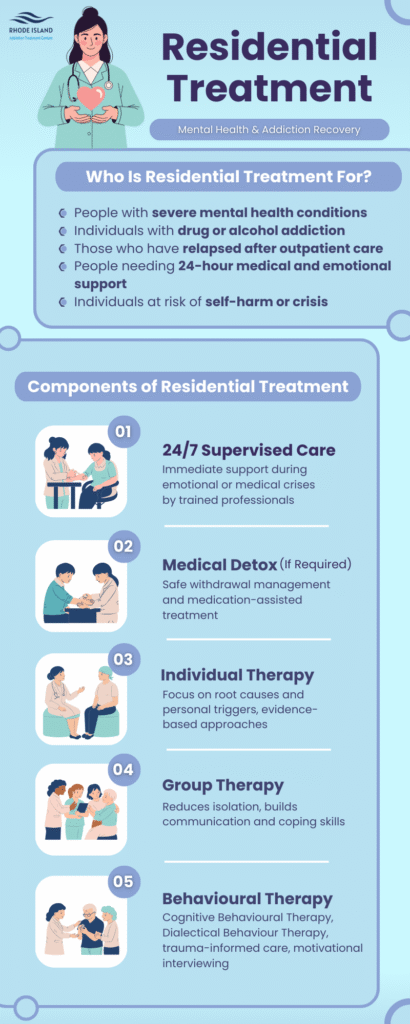
Residential programs blend multiple therapy approaches into daily life, creating layered support that tackles addiction from every direction. Each method serves distinct needs while building toward sustainable recovery.
Individual Counseling: Personal Deep Dives
These private sessions uncover what really drives compulsive patterns. Clients explore trauma and triggers in complete safety.
The focused attention reveals insights groups can’t match, creating genuine self-understanding that anchors long-term sobriety.
Group Counseling: Shared Strength
Hearing others’ stories normalizes the struggle. Participants practice vulnerability and accountability daily.
Those honest exchanges build trust and connection, skills that carry far beyond treatment walls into real relationships.
Cognitive Behavioral Therapy: Practical Rewiring
CBT interrupts automatic relapse thoughts before they gain momentum. Clients master handling stress without old coping mechanisms.
This concrete toolkit proves essential when facing daily pressures post-treatment.
Family Services: Relationship Repair
Addiction damages closest bonds. Guided family sessions rebuild communication while teaching healthy boundaries. Loved ones gain understanding of the recovery process.
These conversations create stable home environments that sustain progress.
Success Factors In Residential Treatment Programs Ri
Factor | Impact |
Length of stay | 90+ days = 2x better outcomes |
Dual Diagnosis care | Cuts readmission 40% |
Aftercare Plan | Most critical success factor |
How To Choose Quality Residential Treatment In Rhode Island
Step 1: Verify Accreditation And Licensing
Start with proven credentials. Licensed facilities follow strict clinical standards that protect quality care. Check state licensing through the Rhode Island Department of Health records. Nationally accredited programs often exceed minimum requirements.
This foundation ensures professional oversight from day one.
Step 2: Evaluate Staff Qualifications
Clinical staff ratios reveal true capability. Ask about licensed therapists versus paraprofessionals. Programs with master’s-level clinicians deliver deeper Individual Counseling work.
Credentialed addiction specialists understand Co-Occurring Disorders patterns better than general counselors.
Step 3: Review Treatment Outcomes
Recidivism rates tell the real story. Strong programs track alumni success beyond 90 days. Ask for completion rates and six-month sobriety statistics.
Facilities publishing outcomes demonstrate confidence in their approach.
Step 4: Confirm Aftercare Infrastructure
Continuing Care prevents the deadly gap. Quality programs coordinate Outpatient Program handoffs before discharge. Verify that alumni support groups and sober living partnerships exist.
Seamless transitions sustain momentum gained during residential stay.
Step 5: Assess Family Program Strength
Family Services integration predicts long-term success. Programs teaching healthy boundaries create home environments that support recovery.
Ask about structured family therapy and education components offered.
Step 6: Test Insurance Process Transparency
Clear verification eliminates surprises. Reputable centers confirm coverage within 24 hours. Written benefit summaries build trust.
Hidden fees waste precious recovery time when urgency matters most.
Real-World Case Study: Minnesota Adult & Teen Challenge Success
A Liberty University study examined graduates from Minnesota Adult & Teen Challenge’s residential program. Researchers identified common traits among completers that boosted program effectiveness and lowered dropout rates.
- Program Design: 12-month live-in immersion with Individual Counseling, Group Counseling, and Vocational Services.
- Key Findings: Graduates showed sustained sobriety through structured Relapse Prevention and family reconnection. Common success factors included motivation, peer support, and Aftercare Plans.
- Outcomes: Reduced recidivism; improved employment and relationships. The study recommends replicating these elements in Rhode Island residential addiction treatment for similar results.
Residential Care Vs Nursing Care Vs Outpatient
Choosing the right care level makes all the difference in recovery. Each option serves distinct needs while building toward sustained freedom from addiction. Understanding these differences helps match treatment intensity to actual circumstances.
Residential Care: Total Immersion For Pattern Change
Adults live onsite 30-90 days in Rhode Island residential addiction treatment. Daily structure eliminates triggers while Individual Counseling and Group Counseling rebuild thought patterns. The focus stays on life skills and Relapse Prevention, not medical crises.
This immersive approach suits complex cases needing a comprehensive reset.
Nursing Care: Medical Stability First
Nursing facilities prioritize health monitoring over therapy. Medication Management dominates while vital signs stay tracked constantly.
Suitable when medical complications overshadow behavioral patterns. Recovery takes a backseat to physical stabilization in this setting.
Outpatient Care: Community-Based Sustainability
Intensive Outpatient Programs balance work, family, and therapy. Clients live at home while attending structured sessions.
Perfect for maintaining gains after residential treatment or milder cases. Flexibility supports real-world application of learned skills.
Your Structured Path Forward Starts Here
Residential Addiction Treatment in Rhode Island delivers immersion that outpatient care cannot match. Daily structure rebuilds broken patterns while Individual Counseling and Group Counseling address root causes. Aftercare Plans sustain hard-won gains through seamless Outpatient Program transitions. Quality matters more than promises.
Rhode Island Addiction Treatment Centers coordinates residential referrals with evidence-based outpatient and intensive outpatient programs for adults 18 and older. Located 10 minutes from Providence, this approach supports real life without upending family or work commitments.
Call 888.541.4028 today. Master treatment coordinators guide personalized next steps. Recovery momentum starts with one structured conversation that clarifies options and builds confidence for the journey ahead.