
24/7 Support, Real Recovery: Residential Rehab Near Warwick, RI Explained
“Recovery emerges from hope.”
Addiction can feel loud and fast, even when the body is tired. A more tranquil context, with an even foundation, may be able to slow things enough for real change to take shape.
According to SAMHSA’s 2023 national facility survey, 17,561 facilities provided substance use treatment services. That number alone demonstrates how many people require structured care and why choosing the right rehab level is important.
At a Residential Rehab Facility in Warwick, Rhode Island, you will live with other addicts, go through daily routines of meetings and therapy sessions, and be monitored. Residential rehab is intended to minimize triggers and replace the chaos with a schedule, therapy, and recovery skills.
In this guide, you will learn what residential rehab entails, who can benefit from it most, what a day in treatment is like, and how to find a program that combines therapy with aftercare.
What A Residential Rehab Program Near Warwick, Rhode Island Really Means
A Residential Rehab Program Near Warwick, Rhode Island is an organized treatment and education program delivered in a 24-hour residential setting with staff available around the clock. You stay temporarily at the facility so you can focus on recovery without daily distractions.
This level of care helps because it reduces access to substances and removes common triggers, while routine supports healthier choices. Inpatient-style structure can also support people who need consistent care for co-occurring mental health concerns during early recovery.
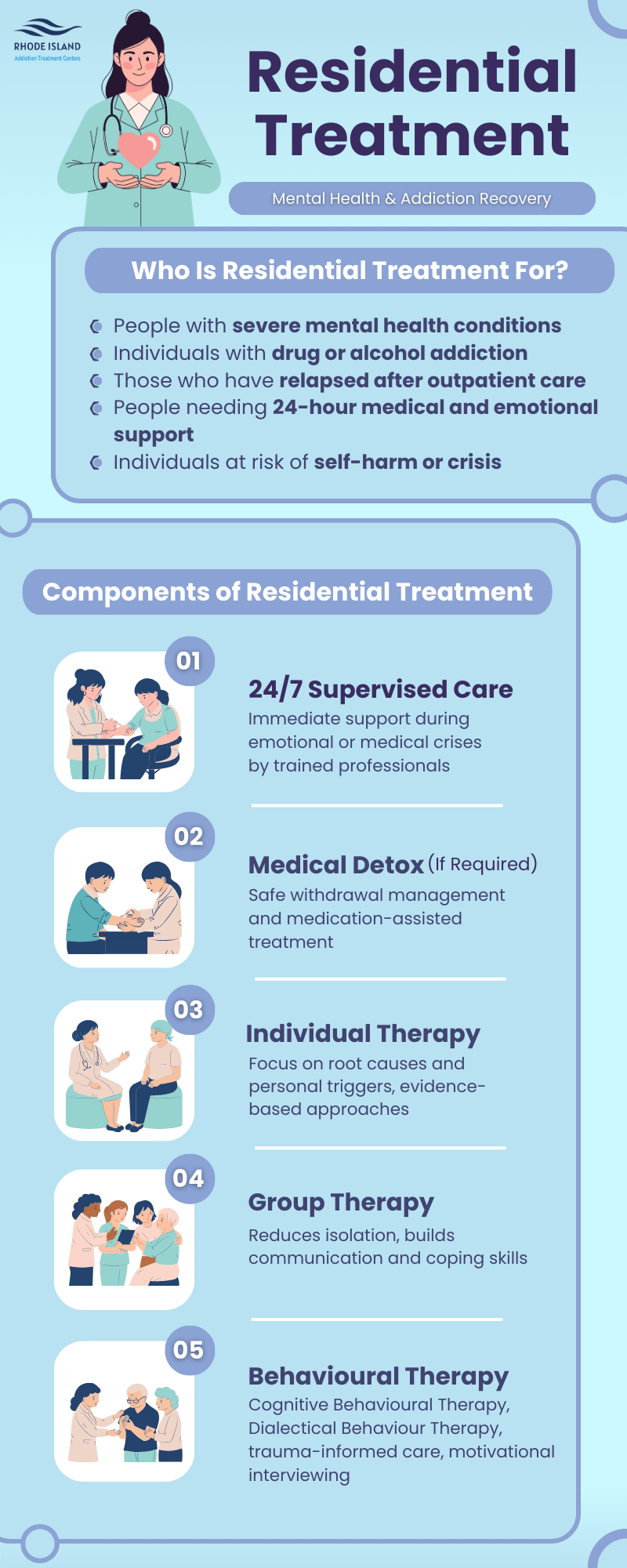
What Residential Rehab Typically Includes
- 24/7 staff support and a stable living environment to build recovery skills.
- Individual therapy and group therapy as core treatment elements.
- Support for co-occurring mental health conditions during treatment.
- Discharge planning and transition into step-down care after residential rehab.
Who Benefits Most From Residential Rehab Near Warwick RI
Residential rehab near Warwick RI often fits people who need more structure than outpatient care can provide. This can include long-term addiction, repeated relapse, or a pattern that gets worse during stress.
It can also be a strong choice when the home environment makes early recovery unstable. When substances are easy to access, or daily conflict is constant, living on-site can protect progress while new habits form.
High-Fit Profiles
- High Relapse Risk: Multiple outpatient attempts, unstable routines, or frequent trigger exposure.
- Co-Occurring Needs: Anxiety, depression, or trauma symptoms that worsen cravings or decisions.
- Unsafe Home Environment: Conflict, unstable housing, or easy access to alcohol or drugs.
How Long Residential Rehab Lasts (And Why Length Matters)
The majority of residential programs follow a 30, 60, or 90-day model, though some do benefit from longer stays when it is clinically indicated. In residential care, the support is referred to as 24/7 support in a structured therapeutic setting, and many programs work with youth in a step-down plan post-discharge.
It matters because recovery skills are things you need to practice over time, in real time, not just theory. Longer care can offer more repetition, more accountability, and more opportunities to troubleshoot the plan when life problems pop up.
| Length | Common Focus | Why It Helps |
| 30 Days | Stabilization and foundation skills | Builds structure and starts therapy work. |
| 60 Days | Deeper behavior change | More time to practice coping and relapse prevention. |
| 90+ Days | Stronger long-term recovery base | More continuity and support while habits strengthen. |
 For a practical next step, read our latest blog, “How To Choose Safe & Confidential Detox Near Providence, Rhode Island”, to learn what to look for in a detox provider before you commit.
What A Typical Day Looks Like In A Residential Rehabilitation Program
A predictable schedule reduces decision fatigue. When your day is planned, you waste less energy fighting constant choices, and you can focus on healing. Residential programs commonly use daily routines that include therapy and skill building.
At the same time, the routine is meant to prepare you for real life. Each day usually blends therapy, coping practice, and recovery planning so that you leave with a clear next step, not just a “fresh start.”
| Time | Activity | Purpose |
| 7:00 AM | Wake, breakfast, medication check | Start stable and support routine. |
| 9:00 AM | Group therapy | Build accountability and peer support. |
| 11:00 AM | Individual session / clinical check-in | Address drivers of use and mental health needs. |
| 1:00 PM | Skills group (coping, triggers) | Practice tools for cravings and stress. |
| 4:00 PM | Wellness / recreation | Rebuild healthy routines and stress relief. |
| 7:00 PM | Recovery meeting / reflection | Reinforce consistency and support. |
Residential Vs Inpatient Vs Outpatient (Choosing The Right Intensity)
People often mix up “residential” and “inpatient,” but they can mean different settings. Residential rehab is typically outside a hospital, while inpatient treatment is often more medically intensive and hospital-based. Both can involve living on-site, yet the setting and medical intensity may differ.
Outpatient care keeps you at home and is usually best after stabilization, or when home support is stable. In contrast, residential care can be a better “immersion phase” because it combines structured days with 24-hour support.
| Level | Setting | Best Fit When |
| Inpatient (Hospital) | Hospital-based, higher medical intensity | Medical instability or high-risk complications. |
| Residential Rehab | Live-in, structured, 24-hour care | Severe addiction, co-occurring mental health, or unsafe triggers at home. |
| Outpatient | Lives at home, scheduled sessions | Stable home support and lower immediate risk. |
Core Therapies And Services In A Residential Rehab Program Near Warwick, Rhode Island
A strong Residential Rehab Program Near Warwick, Rhode Island, combines therapies that support both behavior change and emotional stability. Residential rehab commonly includes counseling, skill practice, and recovery planning within a structured schedule.
This approach works better when addiction and mental health needs are handled together. Inpatient-style programs often address substance use while also supporting co-occurring mental health concerns that can trigger relapse.
Service Menu
- Individual therapy: Identify triggers, patterns, and relapse loops.
- Group therapy: Practice accountability, boundaries, and communication.
- Family involvement: Education and structured sessions when appropriate.
- Aftercare planning: Step-down scheduling and continuity of support.
How Close-To-Home Convenience Helps (Warwick Area Access)