
Outpatient Rehab in Rhode Island: Recovery Without Leaving Your Life
Nobody decides to get help on a convenient day.
It just happens in the middle of an ordinary Tuesday when suddenly things don’t feel normal anymore. And the moment something inside you shifts? You think about all the reasons why you can’t ask for support.
The kids. The job. The mortgage. The explanation you’d have to give.
Drug overdoses took the precious lives of 329 Rhodians in 2024. A small state. A number that should be impossible. And alongside it, another number that doesn’t make headlines but probably should: hundreds of thousands of Rhode Islanders need substance use treatment in any given year. Yet, most of them never receive it. Not because they don’t want it. Rather, the version of treatment they imagine requires them to disappear, and most people’s lives allow it.
That is the gap outpatient addiction treatment in RI was built to close.
The Picture In Your Head Might Not Be The Whole Picture
When most people hear the word rehab, they picture something specific. A facility. A suitcase. Thirty days somewhere that isn’t here. And that becomes the reason the conversation never starts.
What it leaves out is that the majority of people who receive treatment for addiction receive it as outpatients. They go to sessions. They go home. They keep their jobs, raise their children, sleep in their own beds, and do the hardest work of their lives without anyone at work ever knowing they’re doing it.
This is not a lesser version of care. For many people, it is exactly the right one.
What Outpatient At Rhode Island Means
The outpatient addiction treatment program provides customized treatment solutions that match your personal requirements. The program acknowledges that every individual needs different approaches to achieve their recovery goals. The system provides flexibility, which enables users to receive support that matches their particular needs and difficulties.
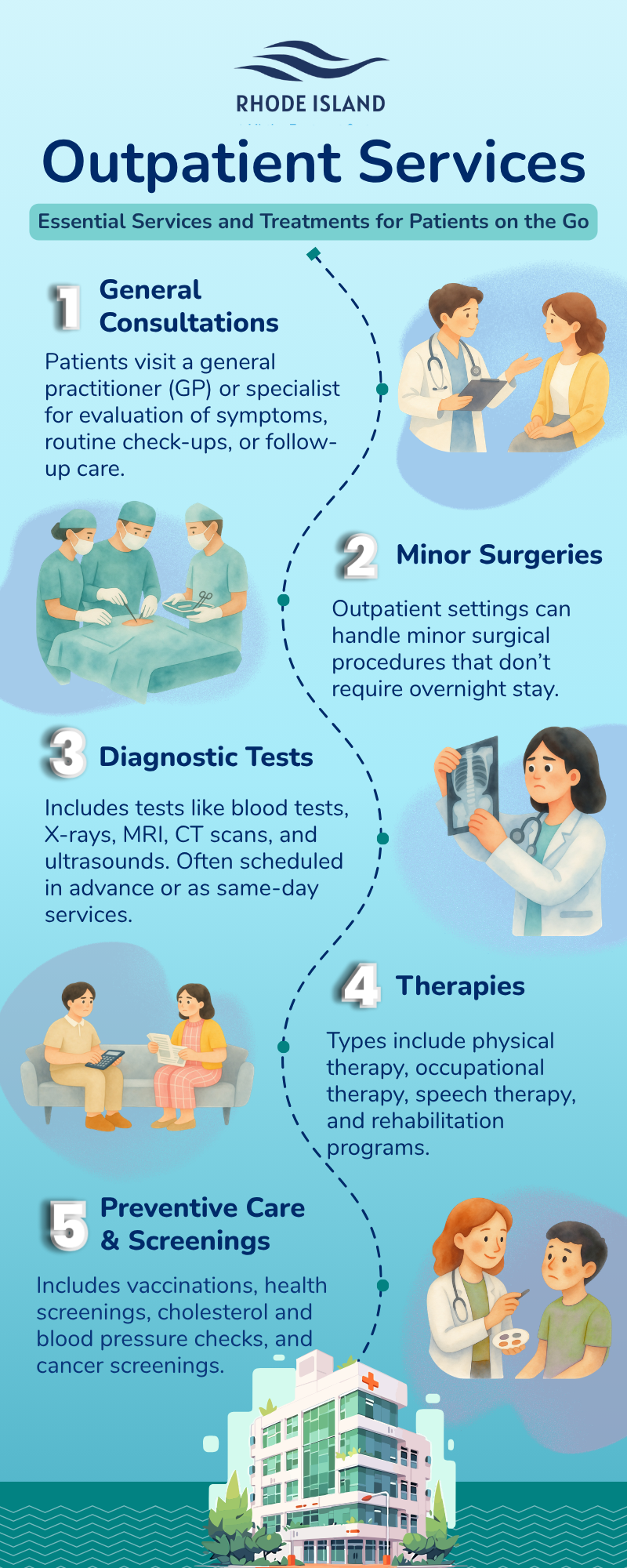
At the least intensive end is standard outpatient care. A few hours a week. Therapy, support, accountability. It works well for someone whose use is early stage or for someone stepping down from a more intensive program who needs continued structure without the full weight of it.
In the middle is the Intensive Outpatient Program. The required treatment schedule demands patients complete nine or more hours of organized therapy during multiple days throughout the week. You come in, you do the work, you go home. It is demanding in the way that anything real is demanding. It is also something you can build a life around, which matters more than it might seem.
At the more structured end is the Partial Hospitalization Program. Full days of treatment, without the overnight stay. It carries the intensity of inpatient care and the continuity of your own life, running both at the same time. For someone who needs more than a few weekly sessions but cannot do residential, PHP is often the answer nobody told them existed.
What Happens Inside The Room
The fear of walking into treatment deserves to be named. Most people assume that they will be asked to speak before they are ready. That the room will feel clinical and exposing. And the people? They don’t know them.
In contrast, what actually happens in a program that is doing its job is quieter than that.
Cognitive Behavioral Therapy works with the thoughts that come right before the behavior. Not in a theoretical sense, but in the specific, personal sense of your thoughts, your patterns, your particular architecture of avoidance. Motivational interviewing doesn’t push. It listens for where your own ambivalence lives and helps you find your own reasons to move. These are not small distinctions. They are the difference between a program that feels like something being done to you and one that feels like something being done with you.
And group therapy, which most people fear most, often becomes the part they are least willing to leave. There is something that happens in a room full of people who have stopped pretending. Something that a one-on-one session, however good, cannot replicate. You will recognize it when you feel it.
Why Staying In Your Life Is Sometimes The Whole Point
The practical case for outpatient care is real. It costs less. It disrupts less. It asks less of your employer, your family, and your calendar.
Nonetheless, the deeper case is something else.
Recovery doesn’t happen in a controlled environment and then get transferred into your life like a file. It grows inside your actual circumstances by introducing new tools to help you cope. You can practice the skills you learn in real-life settings instead of an artificial lab environment. And the support you gain? It comes from people who will continue to be there for you even after your final session. Always ready to cheer for you no matter what.
What you also don’t lose matters. Your role in your family. Your place at work. The sense that you are someone managing something difficult, not someone who has been swallowed by it. These are not peripheral things. For most people, they are exactly what makes recovery feel worth protecting.
What Rhode Island Has Built And What It Still Can’t Do For You
Rhode Island has invested meaningfully in its behavioral health system. The state’s Department of Behavioral Healthcare oversees certified outpatient providers across every county. Parity protections require insurers to cover addiction treatment the same way they cover any other medical care. The infrastructure exists in a way it didn’t a generation ago.
What the infrastructure cannot do is make the first call for you.
At Rhode Island Addiction Treatment Centers, outpatient addiction treatment in RI starts with a real conversation. Not a form, not a benefits summary, not a soft sales pitch.
The shift has already happened. Something brought you here, to this page, reading these words. That doesn’t happen by accident. Rhode Island Addiction Treatment Center is ready when you are, with outpatient programs designed for real lives, real schedules, and real people who have more to hold onto than they can afford to lose. Call us. Let’s talk about what’s next.