
How Much Does Rehab Cost In Rhode Island?
“All Marketplace plans cover mental health and substance use disorder services as essential health benefits.”
That simple reminder from HealthCare.gov matters in Rhode Island, where cost worries often stop people before they ever ask about treatment.
Yet public coverage plays a major role here: as of May 2025, 309,000 children and adults were enrolled in Rhode Island Medicaid, and 76% of Medicaid adults were working. In other words, rehab affordability is not a fringe issue. It affects everyday families. If you are asking how much rehab costs in Rhode Island, the honest answer is that the price varies, but real coverage and lower-cost options do exist.
If you are asking How Much Does Rehab Cost In Rhode Island?, the honest answer is this: the price can range from little to no out-of-pocket cost for some people using Medicaid or state-supported services to much higher self-pay costs for private detox or residential care.
Rhode Island’s own treatment resource guide says many services are free or low cost, and the state’s insurance parity law strengthens access to substance use treatment coverage.
That matters because cost fear stops many people before they even make the first call. Yet Rhode Island gives families more support than they often expect. State law requires many health plans to cover substance use treatment under the same terms and conditions as other illnesses, and Marketplace plans must cover mental health and substance use services as essential health benefits.
How Much Does Rehab Cost In Rhode Island? The Short Answer
The short answer is that the cost of addiction treatment RI depends on the level of care, program length, insurance, and whether the program is in-network.
In simple terms, outpatient care is usually the least expensive, while medical detox and residential inpatient care usually cost more because they involve more staff time, more supervision, and more medical support.
Rhode Island Medicaid guidance and Medicare coverage both show that different treatment levels are handled differently, which is why one person’s cost can look very different from another’s.
Factors That Influence The Cost Of Addiction Treatment RI
The first big factor is the level of care. A standard outpatient plan may include scheduled counseling and follow-up visits, while a higher level of care, such as detox, inpatient treatment, or IOP, involves more hours, more clinical oversight, or 24/7 support. Rhode Island’s Medicaid manual and Medicare both separate these levels clearly, which is a good reminder that “rehab” is not one flat-price service.
The second big factor is how long treatment lasts and how the program is built. A short stabilization stay, a month of residential care, and an ongoing MAT plan are all priced differently. Then there are practical details such as program setting, staff-to-patient ratio, and whether the center offers more medical oversight or more basic community support. It is a bit like booking travel: the destination matters, but so do the room, the extras, and how long you stay.
Factor | Why It Changes Cost | Typical Cost Direction |
Outpatient Therapy | Fewer weekly hours, lower overhead | Lower |
IOP / PHP | More weekly treatment time | Moderate |
Medical Detox | Short-term medical stabilization | Higher |
Residential Inpatient | 24/7 live-in care and staffing | Highest |
MAT | Ongoing medication plus follow-up visits | Varies |
Average Price Ranges For Rehab In Rhode Island
Exact Rhode Island cash prices are not published in one official statewide list, so the safest way to talk about Rhode Island rehab pricing is by pattern, not by pretending there is one fixed number. In real life, some people may pay very little because their plan covers most of the bill, while others may face substantial self-pay charges if they choose a private program or go out-of-network. Rhode Island’s own guide supports the low-cost end of that range, and insurer sources support the fact that many covered behavioral-health services exist across multiple levels of care.
So, what should readers expect? Medical detox and residential inpatient care usually sit at the high end because they are intensive and medically supervised. IOP, PHP, and regular outpatient therapy usually cost less than live-in treatment, especially when insurance is involved. MAT costs can be ongoing rather than one-time, because they may include medication, medical follow-up, and counseling over time. The best next step is always a benefits check, because the “sticker price” is rarely the amount most insured patients actually pay.
Level Of Care | What It Usually Includes | How Pricing Is Commonly Structured |
Medical Detox | Withdrawal support and stabilization | Often per day or short stay |
Residential Inpatient | 24/7 care, therapy, structured support | Often per week or 30-day block |
PHP | Daytime intensive treatment | Often weekly |
IOP | Several therapy sessions a week while living at home | Often weekly or by program |
MAT | Medication plus clinical follow-up | Often monthly plus visit costs |
Does Insurance Cover The Cost Of Addiction Treatment RI?
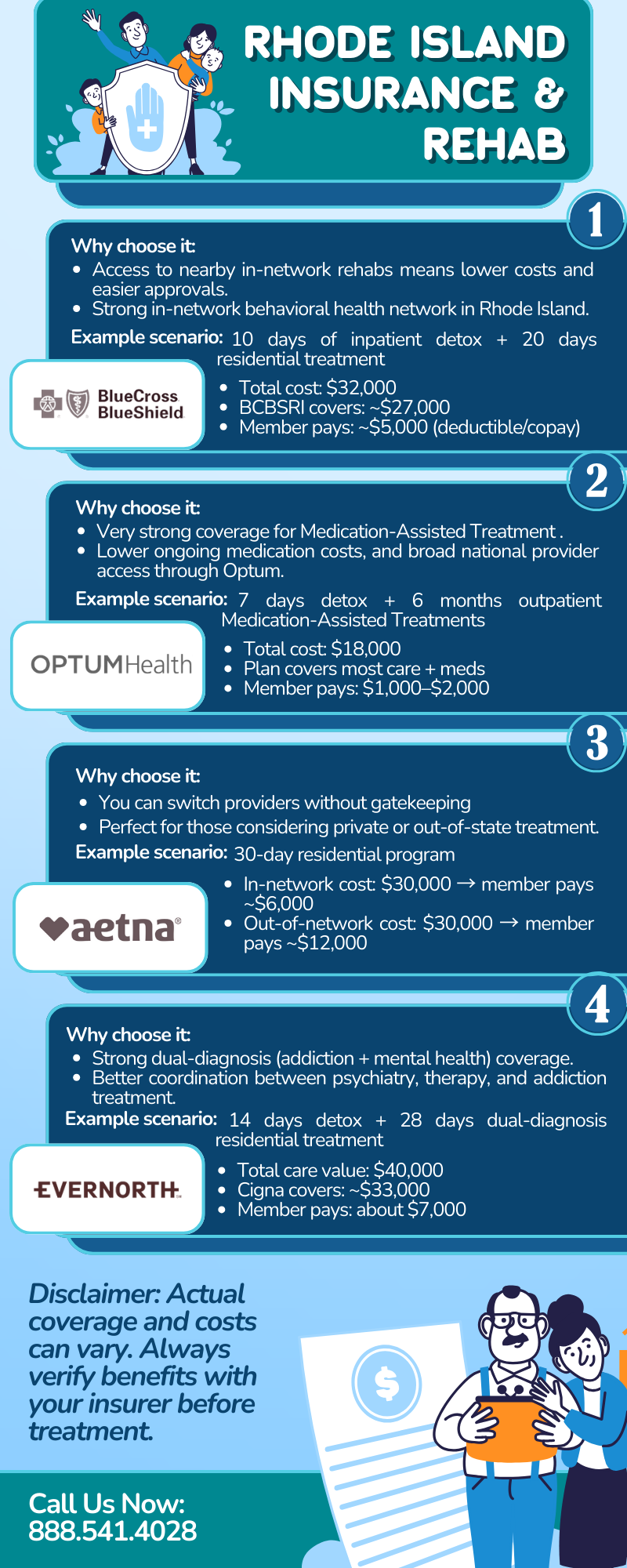
In many cases, yes. Rhode Island’s parity law requires many group and individual plans to cover substance use and mental health treatment under the same terms and conditions as other illnesses. On top of that, HealthCare.gov says Marketplace plans cover mental health and substance use services as essential health benefits. So when readers ask whether insurance helps make affordable rehab RI possible, the answer is often yes, at least in part.
The real difference is usually not “covered or not covered.” It is how much is covered, which level of care is approved, and whether the program is in-network. Neighborhood Health Plan of Rhode Island says it covers behavioral health services, including inpatient care, outpatient therapy, residential substance treatment, crisis stabilization, and IOP. Medicare also covers screenings, services, and programs that aid treatment and recovery for mental health and substance use disorders, including opioid treatment program services and intensive outpatient care.
Coverage Situation | What It Usually Means For Cost |
In-Network | Lower negotiated rates and lower out-of-pocket cost |
Out-Of-Network | Higher patient responsibility and more uncertainty |
Medicaid / Neighborhood | Can greatly reduce or sometimes eliminate patient cost |
Medicare | Can help cover several major behavioral-health treatment types |
Finding Affordable Rehab RI: State-Funded And Low-Cost Options
If private insurance is not part of the picture, do not assume help is out of reach. Rhode Island’s treatment guide says many treatment and recovery services are free or low cost, and BH Link offers a 24/7 walk-in, community-based option for adults who need immediate behavioral-health support and connection to ongoing care. That makes affordable rehab RI more realistic than many families think, especially when a crisis is happening now and time matters.
Public coverage can help too. Neighborhood says it covers behavioral-health services for eligible members, and Rhode Island Medicaid guidance says the program structures benefits to promote access to medically necessary and cost-effective care. Sometimes the hardest part is not the bill. It is knowing where to start.
Good Starting Points For Low-Cost Care
- BH Link for urgent walk-in support
- Rhode Island’s substance use treatment and recovery resource guide
- Neighborhood behavioral-health benefits
- Rhode Island Medicaid information and provider guidance
- A treatment center’s admissions team for a private insurance or benefits check
Steps To Calculate Your Actual Out-Of-Pocket Cost
The easiest way to estimate your own number is to stop guessing and work through three basic items: your deductible, your co-pays or co-insurance, and your out-of-pocket maximum. Those three numbers tell a much truer story than the full program price alone. A treatment center can usually help explain them, and a Verification of Benefits check often takes less time than people expect.
Start with your insurance card, then ask the admissions team whether the program is in-network, whether prior authorization is needed, and what level of care your plan is most likely to approve. That one phone call can clear up a lot of fog. And if the answer is not ideal, you still have options to compare, including lower-cost community resources and public coverage paths.
A Simple Cost Checklist
- Find your member ID and policy details.
- Ask if the program is in-network.
- Ask what your deductible and coinsurance are.
- Ask whether detox, inpatient, PHP, IOP, or MAT are covered.
- Ask what you may owe on day one.
- Ask whether there are payment plans if the balance is still too high.
The ROI Of Recovery: Cost Of Rehab Vs. Cost Of Addiction
Beyond the basic price tag, there is a bigger truth here: addiction is expensive too. It can drain money through substance use itself, lost work, medical emergencies, legal problems, and instability at home.
Rehab may feel costly in the moment, but untreated addiction often keeps sending the bill, month after month. Sometimes the cheaper choice today becomes the most expensive choice later.
Case Study
A useful Rhode Island case study comes from the state’s Comprehensive Demonstration Interim Evaluation Report. The report found that Medicaid members using BH Link services had much stronger follow-up after mental health-related emergency visits than comparison members.
Specifically, 30-day follow-up after an ED visit for mental illness was 276.3 per 1,000 for BH Link users, compared with 159.3 per 1,000 for comparison members.
The same evaluation describes BH Link as part of Rhode Island’s strategy to rebalance care away from high-cost settings and connect people to the right level of support faster.
For families worried about treatment cost, that is important: a timely, lower-barrier connection can improve continuity of care.
FAQs
Is There Free Rehab In Rhode Island?
Some services in Rhode Island are free or low cost, according to the state’s own treatment and recovery resource guide. Public options and crisis-entry services can reduce the financial barrier significantly.
Can I Use My HSA Or FSA To Pay For Treatment?
In many cases, yes. IRS guidance says medical expenses include costs for the diagnosis, cure, mitigation, treatment, or prevention of disease, and those rules are the basis for eligible HSA and FSA medical spending.
What Happens If I Lose My Job While In Rehab?
Losing job-based coverage can qualify you for a Special Enrollment Period to enroll in a Marketplace plan, and COBRA may also be an option. HealthCare.gov says people who lose job-based insurance can enroll in Marketplace coverage and may have 60 days to do so.
Are Payment Plans Available For RI Addiction Centers?
Some centers may offer payment plans or help you explore lower-cost options, but this varies by provider. The most reliable way to know is to ask the admissions or billing team directly during your benefits check.
Conclusion: Don’t Let The Price Tag Stop You
So, How Much Does Rehab Cost In Rhode Island? It depends, but that does not mean the answer is out of reach. Between Rhode Island’s parity protections, Marketplace coverage rules, Neighborhood, Medicare, Medicaid pathways, and low-cost state resources, there are real options for many budgets. The key is to move from fear to facts as quickly as possible.
If you are ready to get a real number, the best next step is a private insurance check or a call with an admissions team at Rhode Island Addiction Treatment Centers. One short conversation can tell you far more than hours of worrying ever will. And when recovery is on the line, that first practical step can make all the difference.