
A Clear Guide To Does Insurance Cover Rehab RI And Addiction Treatment Coverage RI
“Mental health and substance use disorders are every bit as important as physical health.”
That reminder from HHS matters in Rhode Island, where insurance access can shape whether treatment begins quickly or gets delayed.
In fact, a Rhode Island analysis found that the rate of medication-assisted treatment among Medicaid enrollees increased 76% between 2012 and 2018, while more than 80% of first-time 2014 MAT enrollees were covered by Medicaid. That is why understanding insurance coverage matters so much. In many cases, rehab is covered in Rhode Island, but the exact amount depends on your plan, network, and level of care.
Rhode Island law requires group and individual health plans to cover treatment for mental health and substance use disorders under the same terms and conditions as other illnesses and diseases, and Marketplace plans must cover mental health and substance use services as essential health benefits.
That does not mean every plan pays every dollar. Coverage still depends on your insurer, your network, your deductible, and the level of care you need. Even so, many people find that treatment is more affordable than they expected once they actually check rehab coverage RI instead of guessing. Rhode Island’s own treatment guide also says many treatment and recovery services are free or offered at low cost.
Why Insurance Verification Is Your First Step
When someone is ready for help, money questions can feel like a wall. That is why insurance verification addiction treatment matters so much. It gives you a real picture of what your plan may cover before you commit, and it helps you move from panic to a plan. A quick benefits check can also show whether detox, inpatient care, outpatient therapy, PHP, IOP, or MAT may be included under your policy.
Just as important, verifying benefits early can save time. Butler Hospital says it tries to verify insurance before admission, and it notes that some policies require pre-approval or certification. In other words, checking first is not just smart; it can keep treatment from getting delayed by paperwork.
Understanding RI Parity Laws (The Legal Support)
Rhode Island has strong legal support for behavioral health coverage. Under Rhode Island General Laws § 27-38.2-1, group and individual plans must cover treatment for mental health and substance use disorders under the same terms and conditions as other illnesses and diseases. The law also limits more restrictive financial requirements and treatment limits for these services.
That matters because it supports real access, not just nice language on paper. Rhode Island’s updated statutory language also includes medication-assisted treatment, and the Affordable Care Act adds another layer of support by requiring Marketplace plans to cover mental health and substance use disorder services as essential health benefits. So, when people ask, does insurance cover rehab RI, the legal answer starts from a much stronger place than many expect.
What RI Health Insurance Parity Means In Simple Terms
- Your plan cannot treat addiction care like a lesser benefit.
- Copays, deductibles, and visit limits cannot be more restrictive than they are for comparable medical care.
- Coverage still depends on your exact policy, but the rules are designed to protect access.
Major Insurance Providers For Rehab In Rhode Island
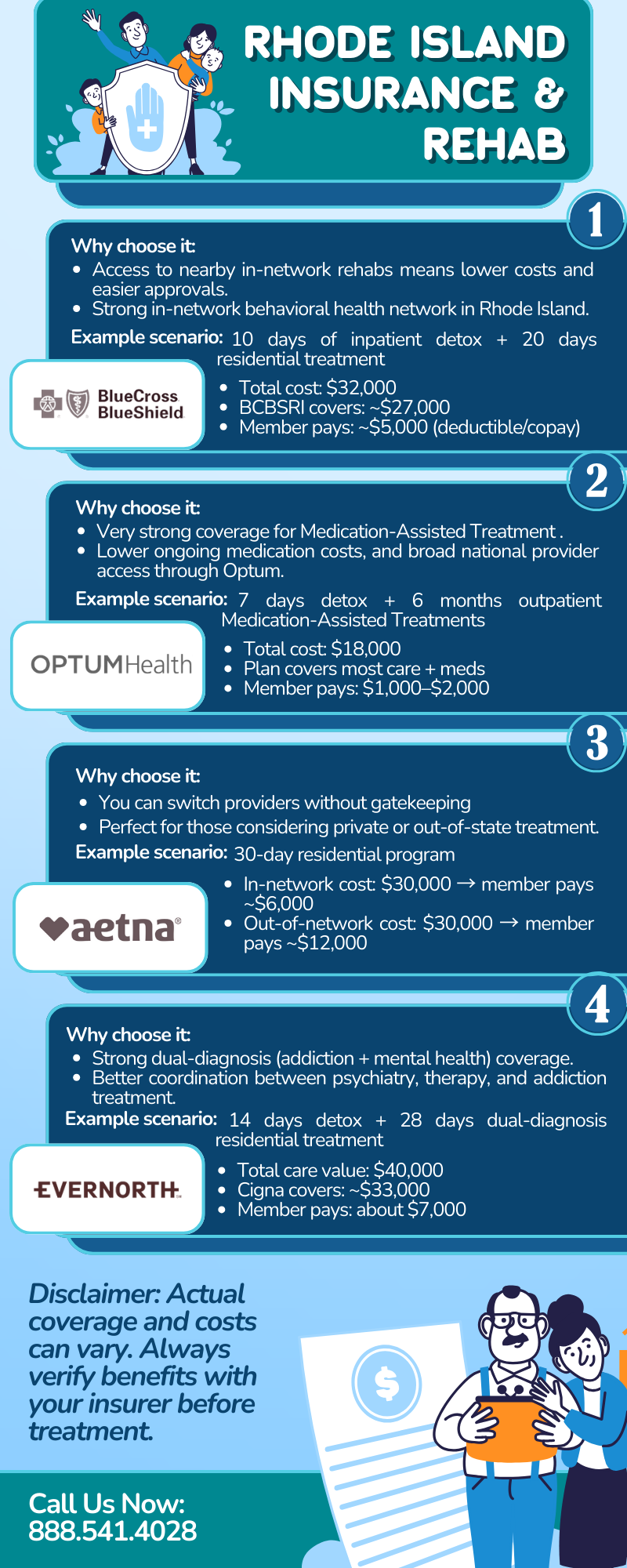
Several major insurers are commonly part of the Rhode Island rehab conversation. Blue Cross & Blue Shield of Rhode Island has a behavioral health and substance use support pathway for members. Neighborhood Health Plan of Rhode Island says it covers behavioral health services, including mental health and substance use treatment. Medicare also covers certain screenings, services, and programs that aid in treatment and recovery for mental health and substance use disorders.
Commercial plans such as Aetna, Cigna, Tufts, and sometimes UnitedHealthcare may also help pay for care, but coverage is always plan-specific. AdCare’s Warwick location says it accepts many major insurers, including Blue Cross Blue Shield, Cigna, Aetna, Tufts, and Rhode Island Medicaid. Tufts also says its plans cover outpatient counseling and inpatient mental health and substance use disorder services. So yes, addiction treatment coverage RI is common, but the exact details need to be verified plan by plan.
Common Plans People Ask About
Insurance Type | What To Know |
BCBSRI | Offers behavioral health and substance use support for members |
Neighborhood / Medicaid | Covers a range of behavioral health services, including higher levels of care |
Medicare | Covers mental health and substance use services, including some outpatient and opioid treatment services |
Aetna / Cigna / Tufts / Others | Often accepted at treatment centers, but benefits vary by plan and network |
The summary above reflects insurer pages and Rhode Island provider information.
 If you need help quickly after reviewing coverage and treatment options, read our latest blog, “Same-Day Rehab Admissions In Rhode Island,” for practical guidance on moving from insurance questions to immediate care without unnecessary delay.
What Types Of Treatment Are Covered? (Levels Of Care)
Insurance does not just cover “rehab” as one big category. It usually covers specific levels of care. Rhode Island Medicaid guidance includes substance abuse treatment services such as outpatient treatment, day treatment, family therapy, and methadone maintenance, while Neighborhood says it covers inpatient care, outpatient therapy, PHP, residential substance treatment, crisis stabilization, peer services, and IOP. Medicare also covers intensive outpatient program services and opioid treatment program services.
That is why the right question is not only “Does my insurance cover rehab?” A better question is “Which level of care does my insurance cover for my situation?”
A short detox stay, a 30-day residential stay, and an outpatient program are not reviewed the same way. Most plans look at medical necessity, network status, and prior authorization rules before approving a level of care.
Levels Of Care Often Reviewed During Does Insurance Cover Rehab RI Checks
Level Of Care | What It Means | What Insurance Usually Looks At |
Medical Detox | Short-term stabilization during withdrawal | Safety, symptoms, medical necessity |
Residential Inpatient | 24/7 care in a structured setting | Severity, risk, progress, authorization |
PHP | Day treatment with high clinical support | Ongoing symptoms and functioning |
IOP | Several therapy sessions each week while living at home | Clinical need and treatment plan |
MAT | Medication plus therapy and support | Diagnosis, formulary, provider network |
This table summarizes treatment categories described in Rhode Island Medicaid, Neighborhood, and Medicare sources.
How To Verify Your Insurance (Step-By-Step)